Solo trekking in restricted areas of Nepal was, for a long time, simply off the table for most independent travellers. The old rules required a minimum of two foreign trekkers per group, which meant solo adventurers had to either find a stranger to share their permit or skip the trek entirely. For the kind of person drawn to places like the Manaslu circuit or the Tsum Valley, that was a frustrating barrier. But as of 22 March 2026, the Department of Immigration changed that.
This is one of the more meaningful shifts in 2026 Nepal trekking policy in recent years. Nepal eases its long-standing group rule for restricted area trekking, and the new system now allows solo trekkers to obtain permits through a registered trekking agency. The change came after sustained lobbying by the Trekking Agencies' Association of Nepal (TAAN), and it affects all restricted areas in 13 districts across the country.
This guide from Nepal Everest Base Camp Co. covers everything you need to know before you go. It explains what changed in Nepal’s restricted areas, which regions are open to solo trekkers, how the restricted area permit process works, what rules for solo travel still apply, and how to plan a realistic, well-prepared solo trek in Nepal in 2026.
What Changed: Why Solo Trekking Is Now Allowed
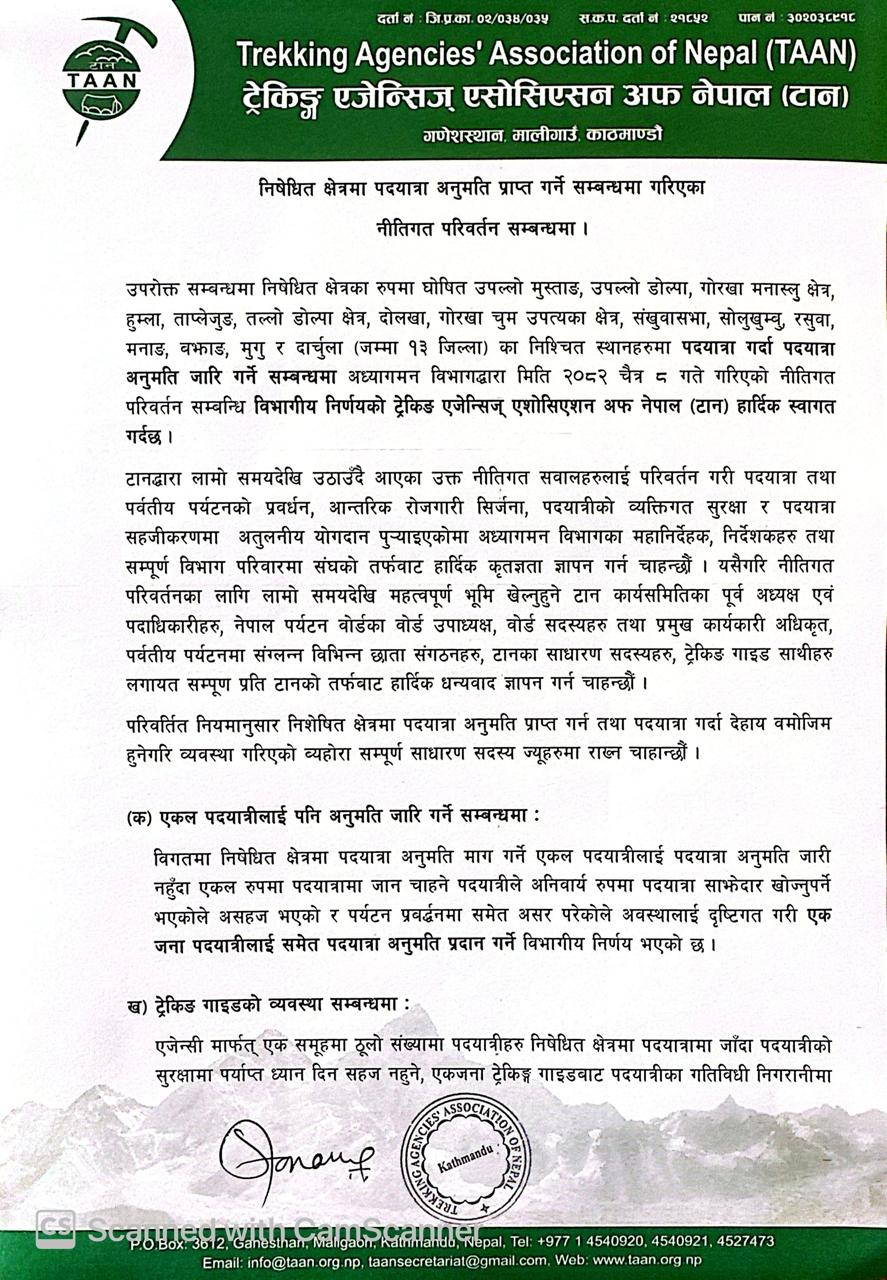
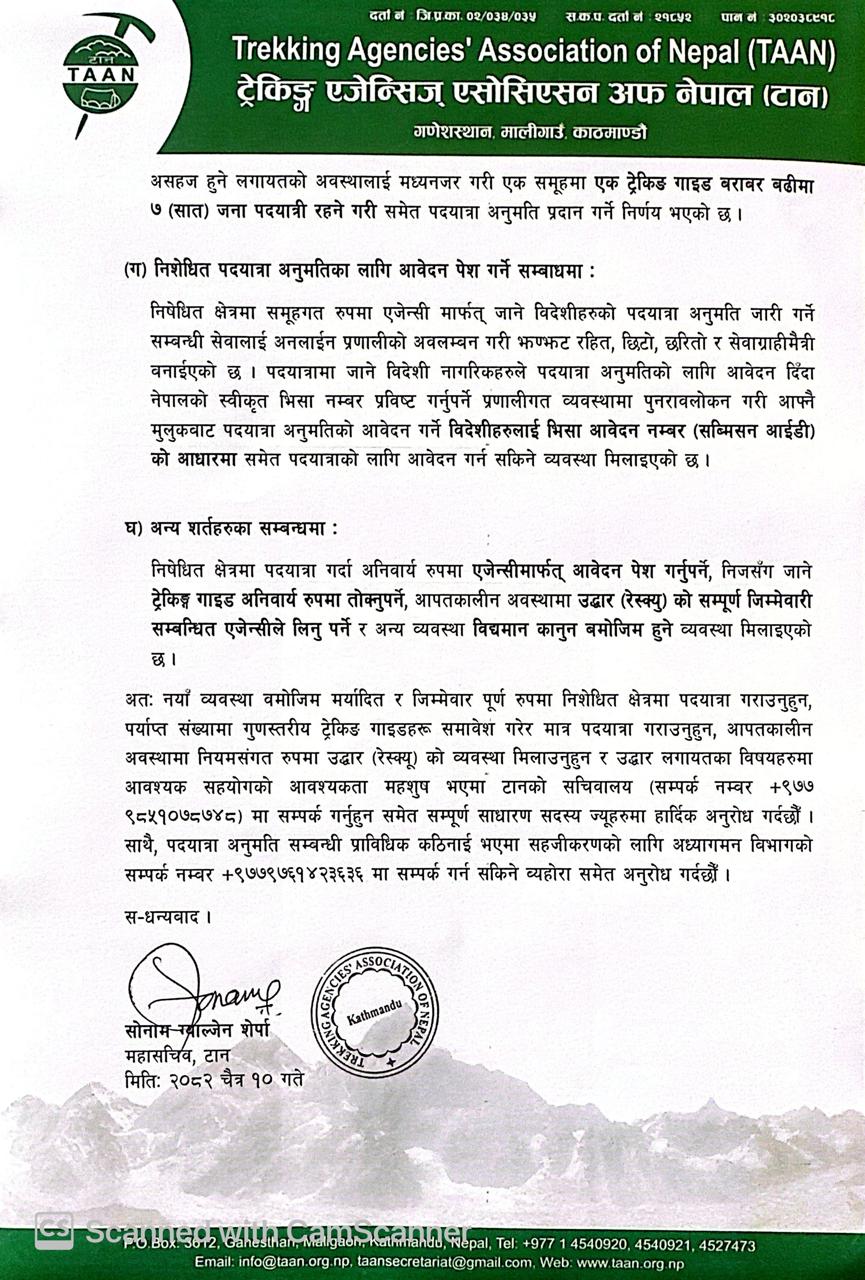
For years, solo foreign trekkers in restricted zones had no legal path forward unless they paired with another foreign national. That rule was not arbitrary. It existed partly for safety and partly for administrative oversight. However, in practice, it created loopholes where trekkers registered as groups but travelled independently. TAAN, the Trekking Agencies' Association of Nepal, formally proposed the change to address this gap and to open remote regions to the broader tourism market. The government, in turn, eases rules for solotrekkers by acting on that proposal within weeks.
TAAN's proposal and the government decision:
TAAN submitted a formal letter to the immigration department in Kathmandu in March 2026, citing lost revenue, reduced visitor numbers in remote communities, and a widespread workaround culture in the permit system.
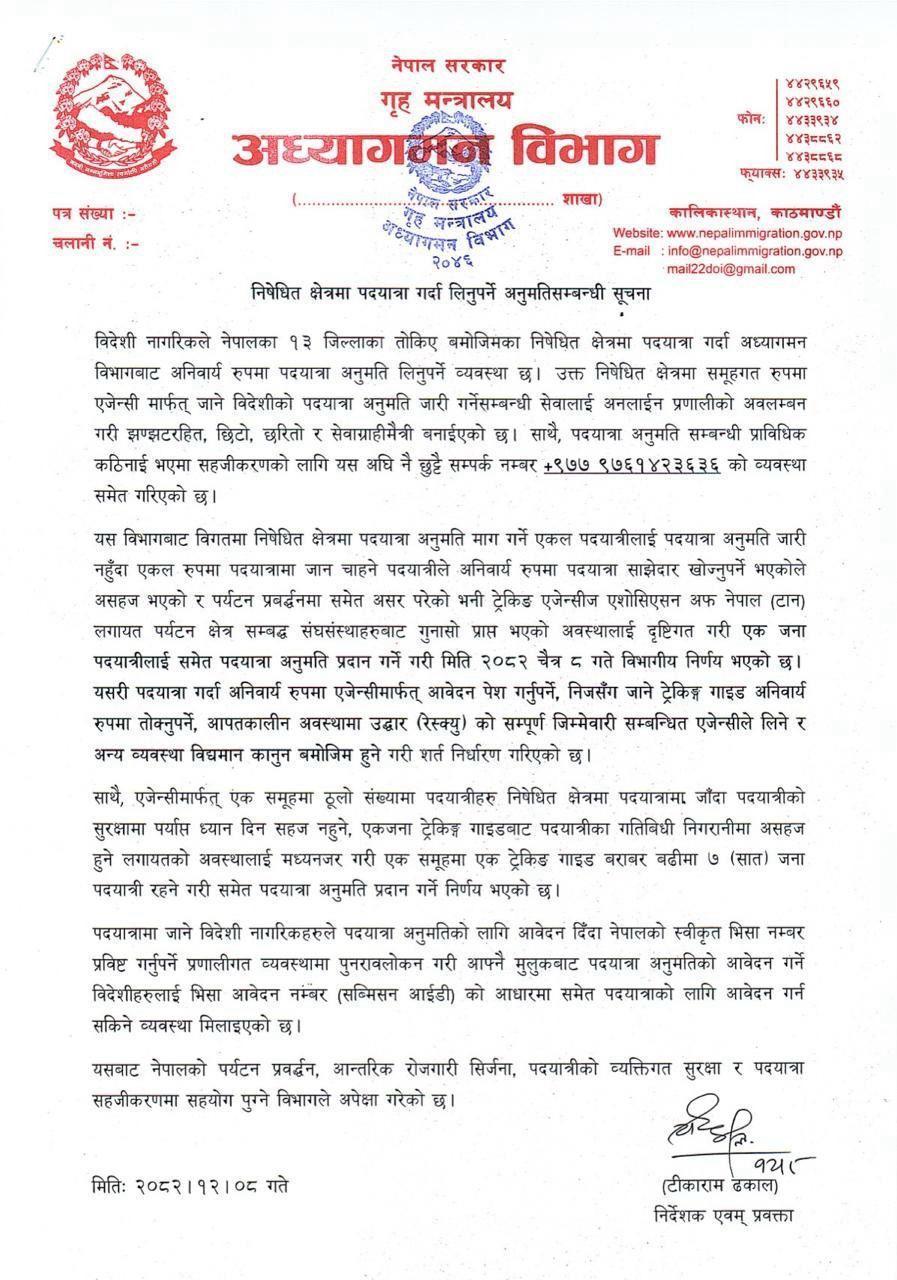
The Department of Immigration reviewed the proposal and issued its decision on 22 March 2026, making it one of the fastest policy responses in recent Nepal trekking history.
The notice, signed by DoI Director Tikaram Dhakal, confirmed that allowing solo foreign trekkers to access designated restricted areas was now official.
What the two-person rule was:
A minimum of two foreign nationals was required on any single restricted area permit.
Solo travellers had no way to apply through a registered trekking agency for an individual permit.
The rule was in place under the Immigration Act 2049 and its associated regulations.
What the new policy allows:
Individual trekkers can now obtain a restricted area permit without needing a second foreign national, meaning they are fully allowed in restricted areas under the updated system.
All applications must still go through a registered trekking agency. There is no self-application route.
A licensed trekking guide remains mandatory throughout every trek in a restricted area.
The agency that processes the permit takes on full legal responsibility for emergency rescue and safety logistics.
Taan Proposal summit
Quick Comparison: Old vs New Rules
The shift is clear when you put both systems side by side. The table below covers the four factors that matter most to anyone planning a solo trek in a Nepal restricted area.
Minimum Trekkers: Previously required 2 foreign nationals. Under the 2026 rules, 1 is permitted, meaning solo trekking is now allowed.
Maximum Trekkers: Previously had no upper limit. Now capped at 7 trekkers per permit.
Guide Requirement: Previously 1 guide for any group size. Now 1 guide per group, covering up to 7 trekkers.
Independent Travel: Previously not applicable. The current regulations still forbid it. An agency remains required.
Permit rules for agency involvement are unchanged. Every application goes through an agency.
The cap of seven trekkers per guide was introduced to improve safety monitoring.
Allowing solo travel does not mean unaccompanied travel. A guide stays with you throughout.
Restricted areas with new permit rules still require the same checkpoints, itinerary approval, and duration limits.
What Restricted Areas Mean in Nepal
Restricted areas in Nepal are government-designated zones that require a special permit on top of any national park or conservation area pass. They sit along sensitive sections of the northern and western borders, where ecological value, cultural heritage, and border security all come into play. Not every remote valley qualifies. Only the zones formally gazetted by the Department of Immigration fall under this system.
Restricted trekking areas are different from national parks. You can enter a national park with a standard conservation area pass. However, to enter restricted areas, you need a separate Restricted Area Permit (RAP) issued by the DoI.
Foreign tourists are required to pass through official checkpoints within these zones. Carrying your permit at all times is not optional.
The permit system exists to protect both the trekkers and the communities they pass through, many of which have limited outside contact and fragile ecosystems.
Fees vary significantly depending on the zone and season. Some areas, like Upper Dolpo, carry high per-day costs. Others, like Rasuwa, are considerably more affordable.
Which Restricted Areas Are Now Open to Solo Trekkers
Solo trekkers can now get permits for areas across 13 districts of Nepal. Below is the full official list, with fees sourced from the Department of Immigration. These are the designated restricted areas affected by the new rules.
S.N.
Region
Areas Covered
1
Upper Mustang
Lomanthang RM (wards 1–5), Lo-Ghekar Damodarkunda RM (wards 1–5), Baragung Muktichetra RM (ward 3 and Satang Village, ward 5)
Among the popular restricted area treks, Gorkha Manaslu, Tsum Valley, and Upper Mustang draw the highest number of solo trekkers to visit restricted zones each season. Restricted areas like Manang (Nar-Phu) and Taplejung (Mount Kanchenjunga) are also worth considering for trekkers who want quieter routes. Note that fees vary by season, so always confirm with your agency before you book.
Permit Rules for Solo Trekkers
Permit rules for restricted trekking regions follow a consistent framework, though a few details are specific to solo trekkers under the updated 2026 system. Here is how the trekking permit policy for restricted zones currently works.
Restricted Area Permit (RAP) basics:
The restricted area permit is issued by the Department of Immigration in Kathmandu. It is the primary access document for all 13 restricted zone areas.
Foreign nationals who have a valid Nepal visa number can now apply. If applying before arrival, a visa application submission ID is accepted.
For solo foreign trekkers to obtain a permit, they must submit a passport copy, photos, a detailed itinerary, and proof of travel insurance covering helicopter rescue.
The permit policy for restricted areas has not changed in structure. What changed is that individual trekkers no longer need a second foreigner on the same application.
Companion permits and local fees:
In most regions, the RAP must be accompanied by a national park or conservation area permit. These are separate fees.
In addition to the national permission, some rural communities impose local admission fees.
The department has also set up a dedicated support line (+977-9761423636) for applicants facing technical issues with the online system.
How guide requirements still apply:
Every solo traveller must be accompanied by a licensed trekking guide throughout the entire trek.
The guide must be Nepali and hold a valid government licence.
The agency that arranges the trek is legally responsible for guide assignment and emergency rescue planning.
Step-by-Step: How to Get a Restricted Area Permit
Foreign tourists to obtain permits for restricted areas in Nepal must work through an agency at every stage. Here is the process from start to finish.
Documents required:
Passport copy with full validity dates
Two recent passport-size photographs
Nepal visa number or pre-arrival submission ID
Day-by-day trekking itinerary with entry and exit points
The Department of Immigration, having revised its trekking permit policy, now allows foreign trekkers to obtain permits before arriving in Nepal.
Use your visa application submission ID to pay fees and begin processing from abroad.
This removes the old requirement to queue at the DoI office in Kathmandu after landing.
Submission process through agencies:
Contact a registered trekking agency like Nepal Everest Base Camp Co. and confirm your region, dates, and guide availability.
Apply through a registered trekking agency by submitting all documents via email or the agency's intake process.
The agency files the application through the DoI online portal using your visa number and itinerary details.
Arranged through a registered trekking agency means the agency is the legal guarantor of your safety and compliance.
Processing time and collection:
Standard processing takes one to three working days through the online system.
Physical permits are typically collected in Kathmandu before departure or, in some cases, at the trek starting point.
Always carry your original permit at every checkpoint. Digital copies are not accepted at most restricted area entry gates.
Important Rules You Still Must Follow
Rules for solo foreign trekkers in restricted areas of Nepal have not been loosened beyond the group size minimum. Everything else from the original framework applies in full. Many trekkers underestimate this, so it is worth being direct.
Routes and itinerary limits:
Solo trekkers must follow the approved route on their permit at all times. Deviating without authorisation is a permit violation.
Route changes must be requested through your agency and approved before you move.
Official checkpoints:
Trekkers entering restricted zones pass through a series of official checkpoints where their RAP is inspected and logged.
Strict rules apply at border-adjacent checkpoints. In areas like Upper Mustang and Nar-Phu, specific ward boundaries mark the edge of what is permitted.
Duration limits:
Each permit is issued for a fixed duration. Overstaying, even by one day, is a violation with real consequences.
Extensions must be arranged through your agency before the permit expires. Do not assume they can be sorted at a checkpoint.
Border proximity restrictions:
Certain wards within the restricted areas across 13 districts sit close to the Tibetan border. Additional restrictions apply in these zones.
Your guide and agency will know exactly where the boundaries are. Follow their lead.
Reality Check: Solo Trekking vs Independent Travel
Solo trekkers in restricted areas are not independent trekkers in the way the term is usually understood. That gap matters a lot when you are planning. The table below lays out what many trekkers expect when they hear "solo trekking is allowed" versus what the rules actually require.
Factor
Expectation
Actual Conditions
Full Independence
Trek completely alone
Limited. Guide and checkpoints required
Permit Access
Apply directly
Agency application only
Route Freedom
Choose your own path
Fixed approved itinerary
Safety Support
Self-managed
The agency holds emergency responsibility
What this means in practice:
Trekkers per group can now be as few as one. But a licensed guide accompanies every solo traveller at all times.
The maximum of 7 trekkers per guide is the new upper limit. For solo travel, that means one-on-one attention, which is genuinely good for safety.
A maximum of seven trekkers can share a single permit. Groups larger than that must obtain a second permit and a second guide.
Allowing individual foreign tourists to apply for single permits is a meaningful improvement. But it is not deregulation.
In remote regions like Upper Dolpo or Humla, there is minimal rescue infrastructure. Your agency's emergency plan is not a formality. It is the only plan.
Being arranged through a registered agency is not a bureaucratic inconvenience. It is what makes trekking in Nepal's restricted areas legally possible at all.
Seven trekkers per guide is the cap. Going over that requires a second permit and a second guide, regardless of group composition.
Final Thoughts on Solo Trekking in Restricted Areas Now Allowed
Nepal's restricted areas are now genuinely accessible to solo travellers, and that is worth taking seriously. The change is not symbolic. It removes a real barrier that kept many experienced, capable trekkers out of places like Tsum Valley, Nar-Phu, and the high plateau of Upper Mustang for years. But the opportunity comes with the same logistical framework that has always governed restricted area trekking, and that framework is there for good reasons.
For trekking Nepal as a solo traveller under the restricted areas with new permit rules, the practical path is clear. Get your region right, choose a reputable Nepali trekking agency, sort your documents early, and give yourself enough time to plan properly. The permit policy for restricted areas has not been simplified out of existence. It has been adjusted in one specific way, and everything else remains as it was.
Rules for solo travel in Nepal's controlled zones now reflect how independent-minded trekkers actually behave in the field. That alignment is long overdue. Whether you are aiming for the Manaslu Circuit, the caves of Upper Mustang, or the sacred stillness of Tsum Valley, the process is manageable, and the experience, for those who prepare properly, is unlike anything else in Himalayan trekking. For detailed guidance, permits, or planning your solo trek in Nepal, contact us at Nepal Everest Base Camp Co. today.
Immigration Update 2026
Published by Nepal Everest Base Camp Co. based on TAAN's letter to the Department of Immigration in Kathmandu and the official DoI notice dated March 22, 2026.
Solo Trekking in Restricted Areas Now Allowed: FAQs
Can foreigners go on solo treks in Nepal's forbidden areas?
Yes. As of 22 March 2026, solo foreign trekkers can obtain a restricted area permit without needing a second foreign national on the same application. However, all trips must still be arranged through a registered agency, and a licensed guide is compulsory throughout the trek.
Is a guide still mandatory?
Yes. A licensed trekking guide is required by law for all trekkers in restricted areas, regardless of group size. This applies to solo trekkers just as it does to groups, and it will not change under the current permit policy.
How much does a restricted area permit cost?
Costs depend on the region and the season. Upper Dolpo and Upper Mustang both cost USD 500 for the first ten days. Manaslu runs USD 100 per week during peak season. Smaller zones like Rasuwa and Dolakha cost USD 20 per week. Always confirm current fees with your agency before booking.
Can you apply for a permit without an agency?
No. Foreign nationals must apply through a registered trekking agency to obtain permits for trekking in any restricted area in Nepal. The immigration department does not accept direct applications from individual foreign tourists. The agency is the legal guarantor of your safety and compliance.
What happens if you overstay the permit?
Overstaying a restricted area permit is a permit violation and can result in fines, confiscation of the permit, or being escorted out of the zone by local authorities. Extensions must be arranged through your agency before the permit expires. Do not leave this until the last day.
Blending digital strategy with mountain passion, I help adventurers find their way to the Himalayas online. With hands-on experience in Nepal’s trekking trails and a role at Nepal Everest Base Camp Trekking Co., Thamel, I combine SEO expertise with true trail insight.