Everest Expedition Report Update: Current Conditions
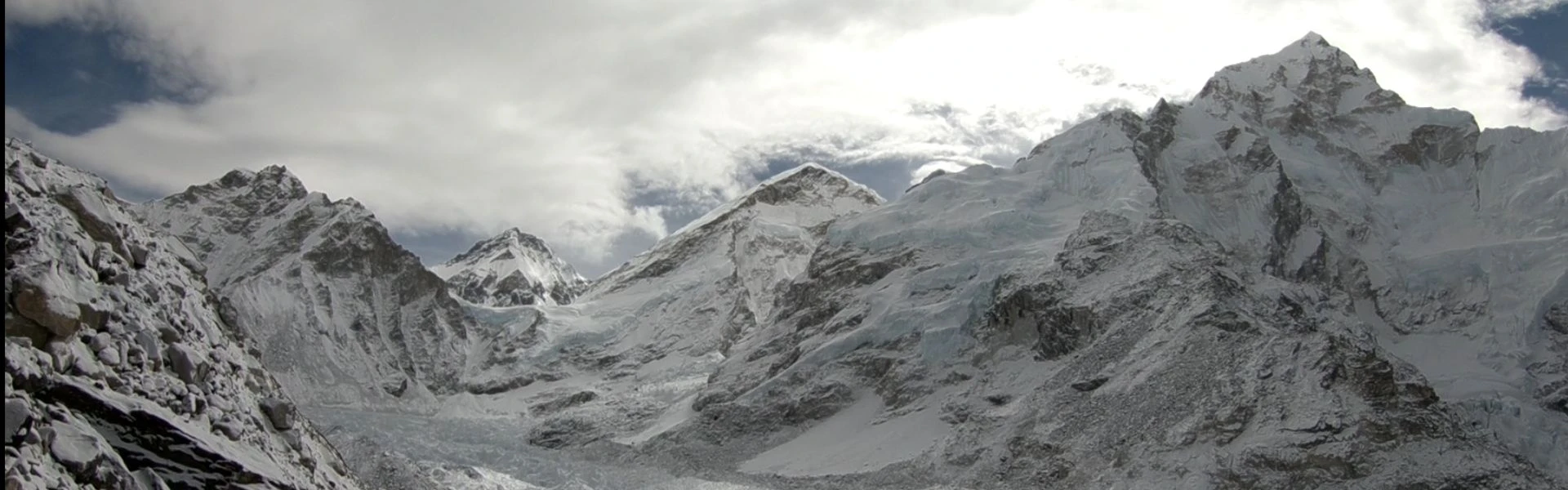
This Everest Expedition Report Update covers the 2026 Everest climbing season, now well under way. As of April 30, hundreds of climbers from 55 countries hold permits for Sagarmatha (8,848.86m), and base camp has grown into a full tent city stretched across the moraine below the Khumbu Icefall. The mountain is being worked on, preparations are serious, and the fixing teams have made real progress. The route to Camp II is now established.
Late April brought a significant shift on the mountain. After weeks of difficult work through the icefall, a joint team completed the critical section from Base Camp through Camp I to Camp II on April 26 and 27. The season has moved from the waiting phase into the active summit progression phase for acclimatised teams.
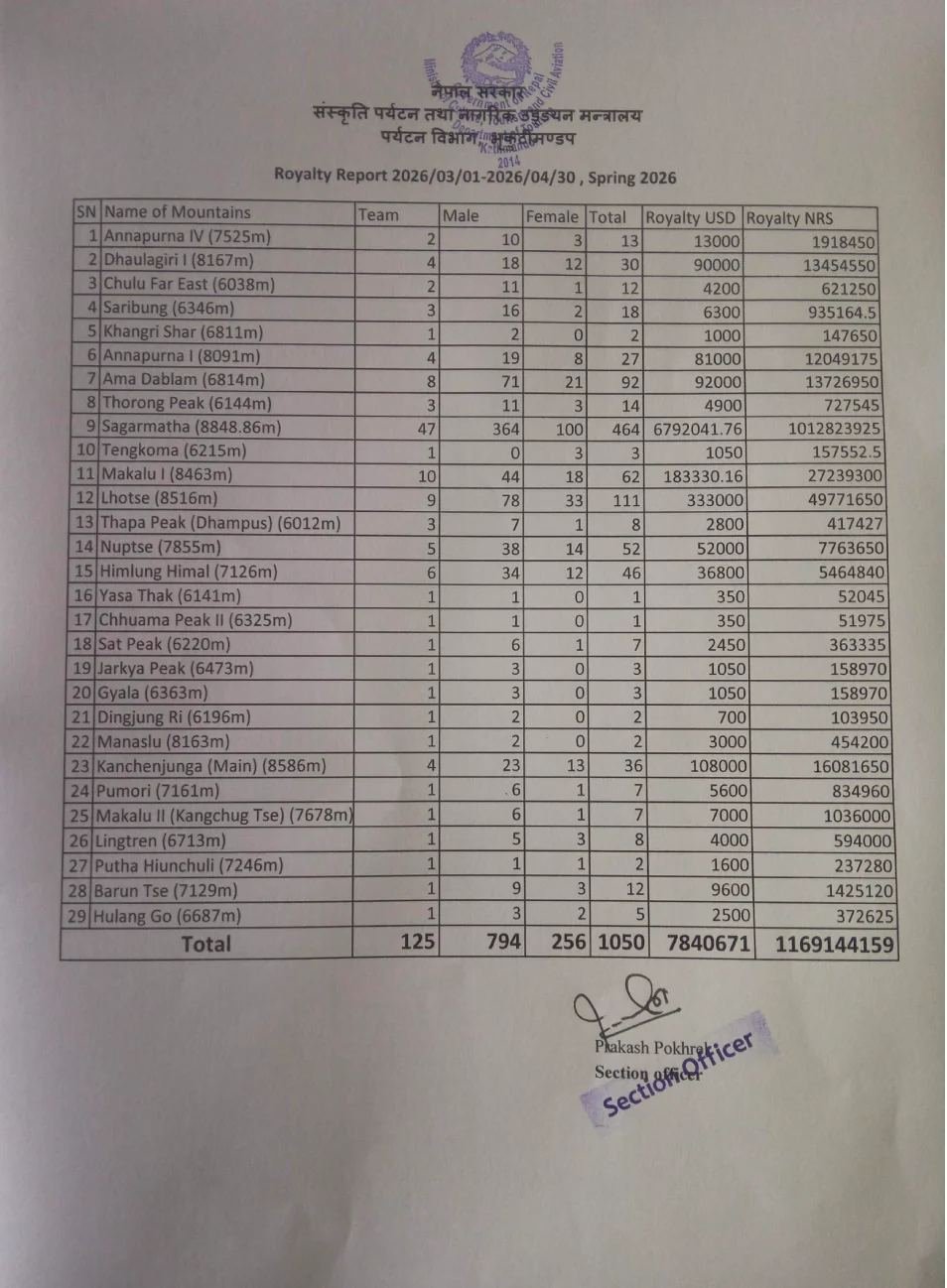
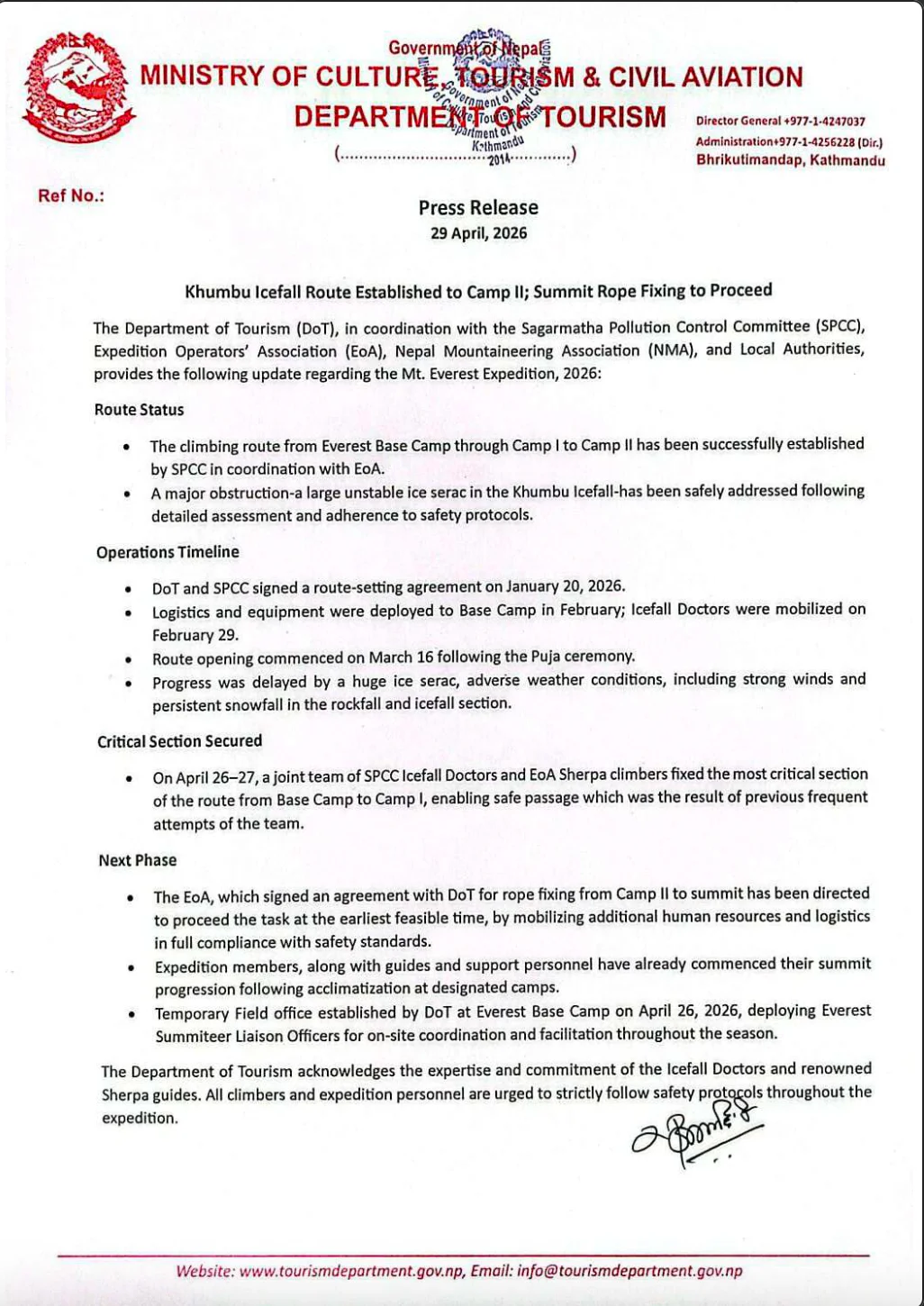
This report draws on official government permit data from Nepal's Ministry of Culture, Tourism and Civil Aviation, the Department of Tourism press release issued on April 29, 2026, and the spring 2026 royalty report signed by Section Officer Prakash Pokhrel. It covers permit numbers, route status, the icefall breakthrough, key risks, and what the current situation means for climbers on the mountain now, in coordination with Nepal Everest Base Camp Pvt. Ltd.
Everest 2026 Season Overview
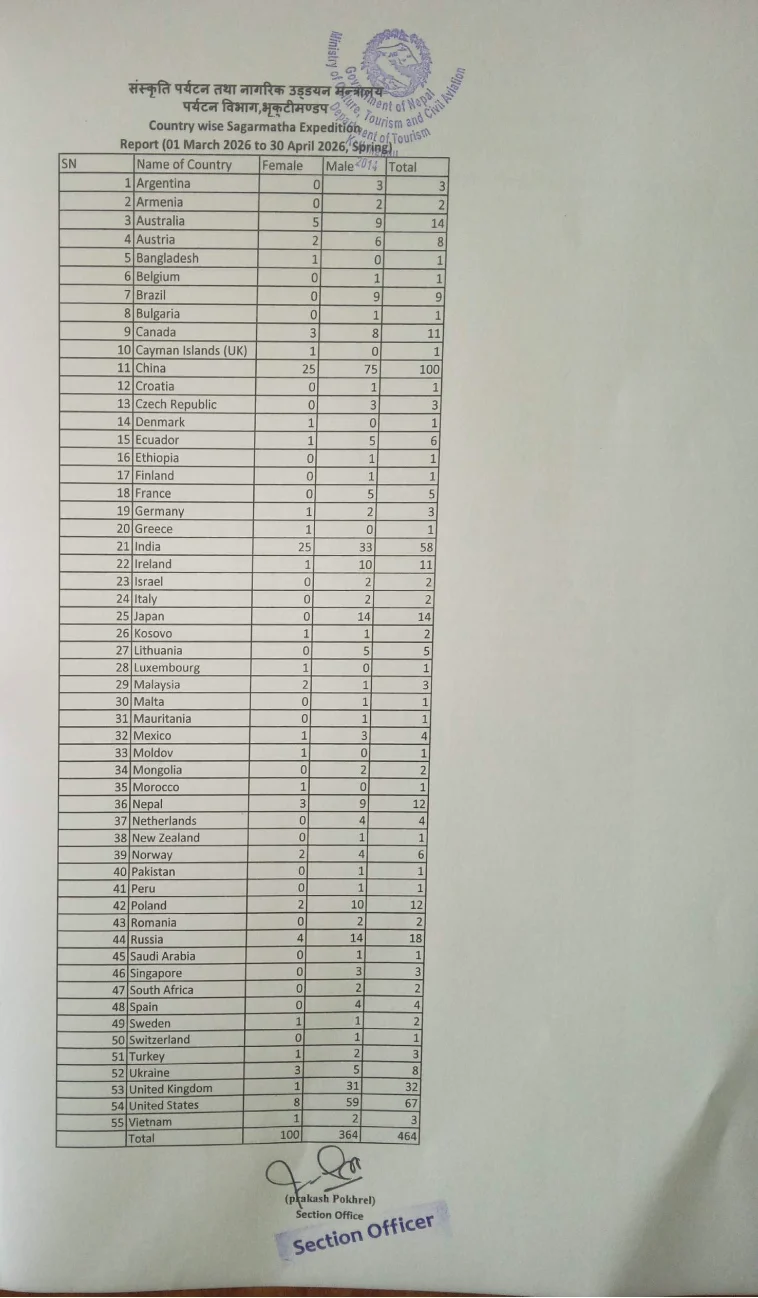
The Everest 2026 season opened with strong demand. According to official royalty records from Nepal's Tourism Department, a total of 464 climbers across 47 teams hold permits for Mount Everest in the spring window from 01 March to 30 April 2026. They represent 55 countries.
Top nationalities by permit count (Sagarmatha):
Country
Female
Male
Total
China
25
75
100
United States
8
59
67
India
25
33
58
United Kingdom
1
31
32
Russia
4
14
18
Japan
0
14
14
Ireland
1
10
11
Canada
3
8
11
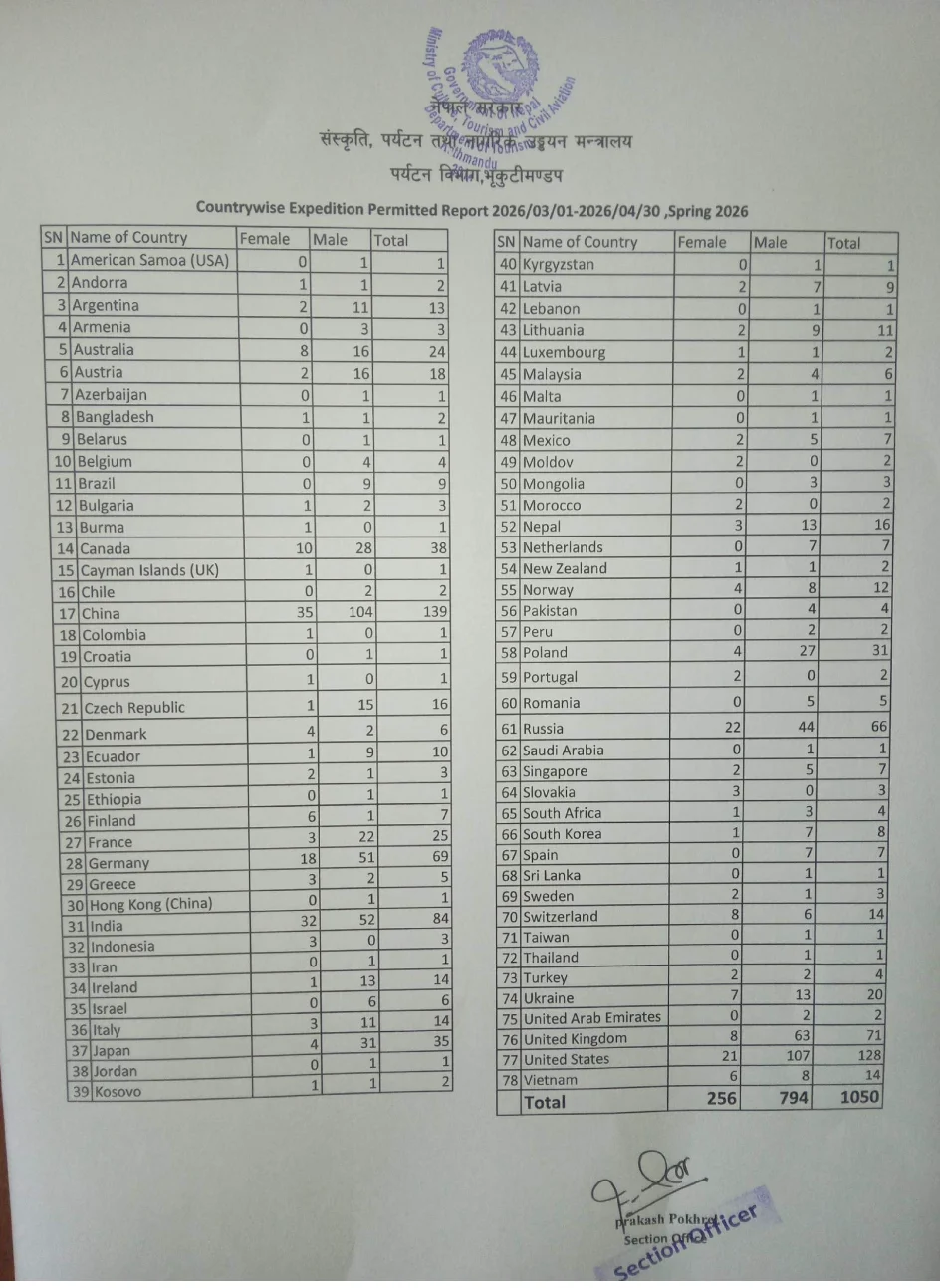
Across all peaks in Nepal this spring, 1,050 total permits were granted across 29 peaks and 125 teams. The royalty for Everest alone reached USD 6,792,041.76 (NRS 1,012,823,925), reflecting both the volume and the permit fee structure. Lhotse (8,516m) is seeing 111 climbers this season. Makalu (8,463m) has 62 climbers. Nuptse (7,855m) has 52 climbers across 5 teams.
Total peaks permitted: 29
Total climbers across all peaks: 1,050
Everest share: 464 of 1,050 (44%)
Royalty across all peaks: USD 7,840,671
For context, these figures place the spring 2026 season among the busiest on record. The Tibet side of Everest remains closed to foreign climbers in 2026, which means the full global demand for Everest permits is channelled through the Nepal route alone. That concentration shows clearly in the numbers.
The season follows the standard pattern: teams fly into Lukla, begin the trek to Everest Base Camp (EBC) at 5,364m, and spend weeks rotating between lower and higher camps before the summit push in May.
mountain expedition Update Data 2026 april 30 page 1
mountain expedition Update Data 2026 april 30 page 2
mountain expedition Update Data 2026 april 30 page 3
Everest Route Status Update: Base Camp to Camp II
As of April 30, the route from Everest Base Camp trek through the Khumbu Icefall to Camp I and Camp II has been successfully established. The Department of Tourism confirmed this in its press release dated April 29, 2026, issued jointly with the Sagarmatha Pollution Control Committee (SPCC), the Expedition Operators' Association (EoA), and the Nepal Mountaineering Association (NMA).
Current route conditions by section:
Section
Status
Base Camp to lower icefall
Open, marked with flags and fixed ropes
Mid-icefall (key ladder crossings)
Fixed and operational
Upper icefall to Camp I
Secured on April 26 to 27
Camp I to Camp II (Western Cwm)
Route established and open
Camp II to summit
Rope fixing in progress
The ladder sections through the icefall required constant repositioning as the glacier moved through the season. The Khumbu Glacier shifts daily. Ice towers crack and adjust, and route markers placed one day can be off-line by the next morning. This is standard for the icefall. What made 2026 harder than usual was the pace of glacial movement through mid-April, which slowed progress at the upper sections considerably.
With Camp II now accessible, teams that have completed their acclimatisation rotations are moving into summit progression. The Western Cwm above Camp I offers more stable terrain, and the route through it is now open. The focus has shifted to the upper mountain.
Major Challenge: Route Delays and Icefall Risks
The Khumbu Icefall is the most dangerous section of the Everest route from the Nepal side. It always is. In 2026, a combination of factors made progress through it slower than is typical for mid-April.
Key risk factors this season:
Serac instability in the upper icefall. A large unstable ice serac required detailed assessment and rerouting before the fixing team could safely pass through. This was the primary cause of the delays in mid-April.
Crevasse widening. The glacial movement this spring opened gaps faster than teams expected in several sections.
Traffic at ladder crossings when multiple teams attempted rotations at the same time.
Overhanging ice at two locations that had shifted since early April, adding further complexity to the route work.
The effects of climate change on the icefall are increasingly cited by expedition planners. The ice behaves less predictably than records from a decade ago suggest it should.
For the Sherpa teams doing the actual fixing work, these risks were not abstract. Five to ten team members moved through the hazard zone daily to place ropes, adjust anchors, and evaluate conditions. The delays came from the terrain, not from a lack of effort or commitment. The fixing teams worked consistently through difficult conditions before the breakthrough on April 26 and 27 made the full route possible.
Official Everest Expedition Update: Government Permission for Icefall Route Work
On 2026/04/24, Nepal's Ministry of Culture, Tourism, and Civil Aviation, through the Tourism Department (Mountaineering Section), issued an official permission letter to the Expedition Operators Association of Nepal (EOAN). The letter is signed by Director Nisha Thapa Raut and addressed to the Mountaineering Operators Association, Thamel, Kathmandu, with a copy directed to the Sagarmatha Pollution Control Committee (SPCC), Solukhumbu.
The letter (Chalan No. 2217) granted formal government authorisation for the following:
Deployment of skilled labour through EOAN member agencies
Safe rope construction and fixing ropes on the Khumbu Icefall route
Route work covering access to Sagarmatha, Lhotse, and Nuptse
Coordination with SPCC for facilitation and logistical support
What this permission meant in practice:
The letter was not routine paperwork. It was issued because the delays had reached a point where a ministerial-level directive was needed to authorise accelerated action. EOAN was given formal authority to mobilise the widest possible pool of skilled fixing labour from across its member agencies. SPCC was placed in an active coordination role, linking logistics between Solukhumbu and base camp.
On April 26, 2026, the Department of Tourism also established a temporary field office at Everest Base Camp, deploying Everest Summiteer Liaison Officers for on-site coordination throughout the season. That office is now operational and working alongside EOAN and SPCC on the ground.
For climbers at EBC, the combination of the government permission letter, the SPCC coordination role, and the field office meant that the institutional framework for a fast resolution was in place. The joint team completed the critical section two days later.
khumbu icefall route updates
Khumbu Icefall Route Now Open to Camp II: What Changed
The breakthrough came on April 26 and 27. A joint team of SPCC Icefall Doctors and EoA Sherpa climbers fixed the most critical section of the route from Base Camp to Camp I. This section had resisted repeated attempts through mid-April because of the large unstable serac that blocked the safest line through the upper icefall.
The serac was assessed carefully, safety protocols were followed, and the team found and secured a viable passage. The Department of Tourism's April 29 press release confirmed that the obstruction has been safely addressed.
What the route breakthrough means in sequence:
January 20, 2026: DoT and SPCC signed the route-setting agreement.
February: Logistics and equipment deployed to Base Camp. Icefall Doctors mobilised on February 29.
March 16: Route opening commenced following the Puja ceremony.
Mid-April: Progress stalled at the upper icefall due to the serac and adverse weather, including strong winds and persistent snowfall.
April 24: Government issued formal permission for accelerated EOAN-led fixing operation.
April 26: DoT temporary field office established at EBC. Liaison Officers deployed.
April 26 to 27: Joint SPCC and EoA team secured the critical Base Camp to Camp I section.
April 29: DoT press release confirmed the full route from Base Camp through Camp I to Camp II is established.
With the icefall route resolved, the EoA has been directed to proceed with rope fixing from Camp II to the summit at the earliest feasible time. Additional human resources and logistics are being mobilised for this phase, in full compliance with safety standards.
Expedition members who have completed acclimatisation at the designated camps have already begun their summit progression. The season is now in its active phase.
Weather Conditions and Climbing Window Forecast
Weather on Everest in spring follows a general pattern: cold and windy through April, with brief windows of relative calm appearing in May. The jet stream sits over the summit for much of the pre-monsoon period, producing sustained winds above 100 km/h at high-altitude sections. Those winds drop periodically, and those drops are the windows that climbers and expedition teams aim for.
Typical April conditions at key elevations:
Elevation
Avg Temperature (April)
Avg Wind Speed
Base Camp (5,364m)
-5°C to -15°C nights
20 to 40 km/h
Camp 2 (6,400m)
-15°C to -25°C
40 to 70 km/h
Camp 4 / South Col (7,900m)
-25°C to -35°C
60 to 120 km/h
Summit (8,848.86m)
-35°C to -45°C
80 to 150 km/h
Veteran Everest climbing forecaster Alan Arnette, who tracks summit conditions annually, has noted that May 15 to May 25 tends to produce the most reliable weather windows in recent seasons. In 2026, early models suggest a similar pattern. The jet stream remained stubborn through mid-April. No reliable summit window has appeared yet, and none is expected until at least early May.
For mountaineer teams now moving into summit progression, the timing aligns reasonably well. The route to Camp II is open. The upper mountain rope fixing is under way. If the May windows arrive on the typical schedule, teams that started summit progression in late April will be well positioned.
Conditions to watch:
Jet stream position through late April and early May
Temperature differentials that signal incoming weather systems
Helicopter availability for supply runs to higher camps, which depends on wind conditions in the valleys
Expedition Progress Timeline (April 2026)
The spring 2026 season has followed a broadly standard schedule, with icefall delays in mid-April adding buffer time to most teams' plans before the late-April resolution.
Key milestones:
Late March to early April: Teams flew into Lukla and began the trek to base camp. Most major expeditions completed their arrival at EBC between April 1 and April 8.
April 5 to April 8: Puja ceremonies held at base camp. For most Himalayan expeditions, no climbing begins before the puja is complete.
April 8 to April 12: First rotation attempts to lower icefall sections. Several teams reached the lower fixed lines before the upper route stalled.
April 10: Teams passing through Lobuche town and Gorak Shep reported active helicopter flights supplying EBC. Logistics chains below the icefall functioned well throughout.
April 12 to April 25: Fixing teams focused on the upper icefall. Most commercial expeditions completed lower-mountain rotations while waiting for the full route.
April 24: Government permission issued to EOAN. DoT field office established at EBC on April 26.
April 26 to 27: Joint SPCC and EoA team secured the critical Base Camp to Camp I section. Route to Camp II established.
April 29: DoT press release confirmed the full route open. EoA directed to begin Camp II for summit rope fixing.
Late April to early May: Acclimatised teams begin summit progression.
Among the notable attempts this season is an effort by the oldest American to summit Everest, which has drawn attention in the wider mountaineering community. That attempt, like all others, depends on the upper mountain rope fixing being completed safely before the first May weather window.
Sherpa Teams and Route Fixing Operations
The fixing operation on the Khumbu Icefall is managed by the Icefall Doctors, a dedicated team of experienced Sherpas appointed specifically to maintain the route from base camp through the icefall each season. They work before most other teams are active on the mountain each morning.
How the operation works:
The Icefall Doctors assess conditions at first light, often using a drone to survey the upper sections before sending teams in.
Fixed rope lines are placed sequentially. Each anchor point is assessed for ice stability before the next section is opened.
Ladder crossings over crevasses are repositioned as the glacier shifts. Several needed repositioning multiple times this season.
Sherpas from commercial expeditions assist with load carrying to lower camp positions once sections are declared safe.
The SPCC coordinates waste management and environmental monitoring along the route, consistent with its mandate from Kathmandu.
The government permission letter formally authorised EOAN to draw skilled labour from across its full membership. This expanded the workforce available for fixing work beyond what any single operator could provide. That pooled model is what made the April 26 to 27 breakthrough possible: SPCC Icefall Doctors and EoA Sherpa climbers worked the critical section together as a joint team.
The operation now shifts to the upper mountain. From Camp II to the summit, rope fixing is the active phase. EOAN has been directed to mobilise additional human resources and logistics for this work, and it will proceed in full compliance with safety standards. The collaboration between EOAN and the SPCC, now with the DoT field office at EBC as an on-site coordination point, gives the operation a firmer structure than in previous seasons.
What This Means for Climbers in the 2026 Everest Climbing Season
The icefall delay is behind most teams now. The route to Camp II is open, summit progression has begun for acclimatised groups, and the upper mountain fixing operation is under way. Teams that planned around a mid-to-late May summit window have the positioning they need.
Strategic considerations by team type:
Team Type
Current Status
Recommended Approach
Commercial guided expeditions
Summit progression begun for acclimatised teams
Follow operator schedule and monitor Camp II to summit fixing
Independent mountaineer teams
Mixed, some already at Camp II
Track upper mountain rope-fixing progress daily
Alpine-style attempts
Viable once Camp II to summit ropes are fixed
Wait for upper rope confirmation before committing
Teams attempting without supplementary oxygen
Moving into active phase
Route condition over timing remains the priority
The season on the Nepal side is also being watched against the Tibetan side, where the northern route on Everest remains closed to foreign climbers in 2026. All global demand for Everest permits moves through a single route. The volume is higher than it would be in a dual-access season, and the trail of 464 permitted climbers will be visible in the congestion at the ladder crossings as the summit phase begins.
Ama Dablam (6,814 m) remains active this season, with 92 climbers across 8 teams holding permits. Some teams use it as a high-altitude acclimatisation peak before shifting focus to Everest.
The number of teams that have summited Everest as of April 30 is zero. This is not unusual. The summit phase does not typically begin until mid-May at the earliest. What late April determines is positioning: which teams are ready, which routes are open, and which operators have their logistics in order. On all three counts, the season has moved into a better position in the last week of April than it was in during mid-April.
Everest Expedition Report Update: Final Insights
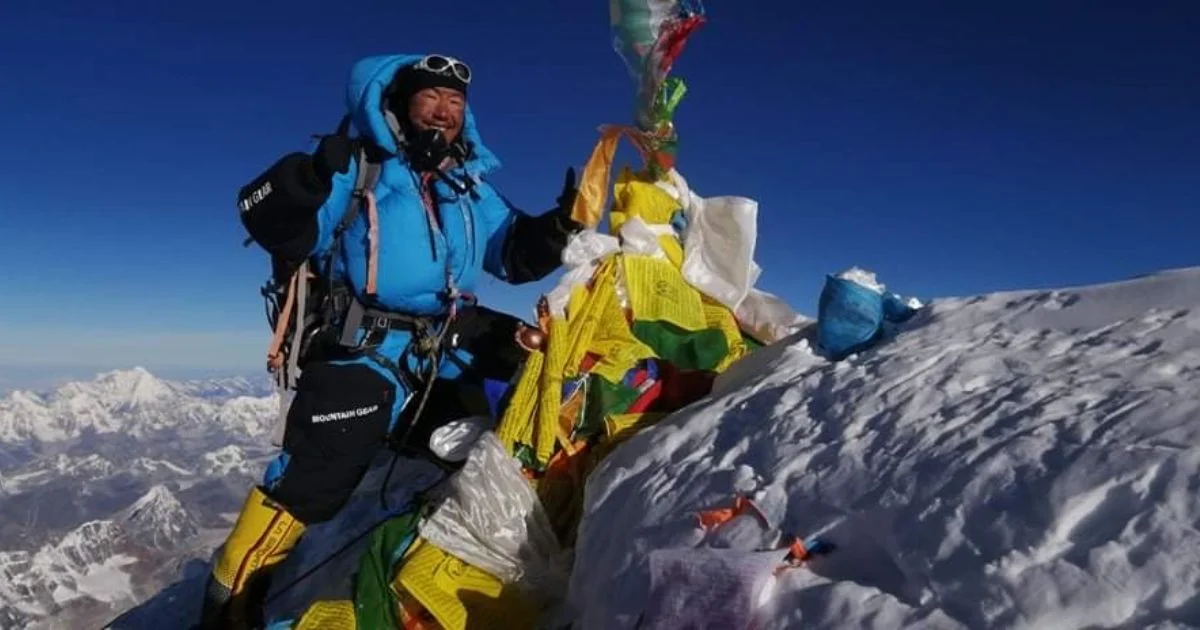
This Everest expedition report update reflects a season that moved through a difficult mid-section and has come out the other side in reasonable shape. As of April 30, the icefall route is open to Camp II; the serac that caused the delays has been safely resolved; and the EoA is now tasked with fixing ropes from Camp II to the summit. The 464 permitted climbers on Sagarmatha are no longer waiting for the route. They are moving.
The Department of Tourism's April 29 press release is the clearest confirmation of where the season stands. The government treated the route delay seriously, issued formal permission for accelerated operations, established a field office at EBC, and backed the joint SPCC and EoA fixing effort that resolved the critical section. That institutional response worked. The result is a season that is now aligned with the May weather windows rather than running behind them.
There is still work ahead on the upper mountain. Camp II to summit rope fixing takes time and carries its own risks at altitude. The summit windows in May will determine which teams are ready when the weather opens. Nepal Everest Base Camp Co. will continue tracking conditions as the season moves into its critical summit phase. Contact us for the latest updates and guided support.
Everest Expedition
Everest Expedition Report Update | FAQs
What Does the Latest Everest Expedition Report Update Show for April 2026?
The latest Everest expedition report update confirms that 464 climbers from 55 countries hold permits for Sagarmatha this spring. The icefall route from Base Camp through Camp I to Camp II was established on April 26 and 27 by a joint SPCC and EoA team. Summit progression has begun for acclimatised teams, and rope fixing from Camp II to the summit is now the active phase of the operation.
Is the Everest route open as of late April 2026?
Yes, to Camp II. The Department of Tourism confirmed on April 29, 2026, that the climbing route from Everest Base Camp through Camp I to Camp II has been successfully established. A major serac obstruction in the upper icefall was safely addressed following detailed assessment. The EoA is now proceeding with rope fixing from Camp II to the summit.
When Do Climbers Usually Begin Their Summit Push?
The summit push on Everest typically begins between May 10 and May 25, depending on weather windows. Teams need a stable two to four-day window with low winds at the peak to make a safe attempt from Camp II and above. Early weather models for 2026 suggest a similar pattern to recent seasons.
How Dangerous Is the Khumbu Icefall This Season?
The Khumbu Icefall carries its standard high risk of serac fall, crevasse collapse, and glacial movement. In 2026, a large unstable serac required significant rerouting through mid-April. That section was safely resolved on April 26 and 27 by the joint SPCC and EoA team. The standard operational risks of the icefall remain, and teams continue to move through it under the management of the icefall doctors.
Do Delays Reduce the Chances of a Successful Summit?
Not necessarily. The mid-April delays gave most teams additional acclimatisation time before the May weather windows. Teams targeting early May windows face the tightest margin, as Camp II to summit rope fixing is still under way. The critical factor remains whether the upper mountain ropes are in place before the first reliable weather window arrives.
How Long Do Climbers Stay at Everest Base Camp Before the Summit Attempt?
Most expedition teams spend five to seven weeks at Everest Base Camp and the surrounding camps before their summit attempt. This includes multiple acclimatisation rotations to progressively higher elevations, rest periods, and waiting for the right weather window in May.
Blending digital strategy with mountain passion, I help adventurers find their way to the Himalayas online. With hands-on experience in Nepal’s trekking trails and a role at Nepal Everest Base Camp Trekking Co., Thamel, I combine SEO expertise with true trail insight.