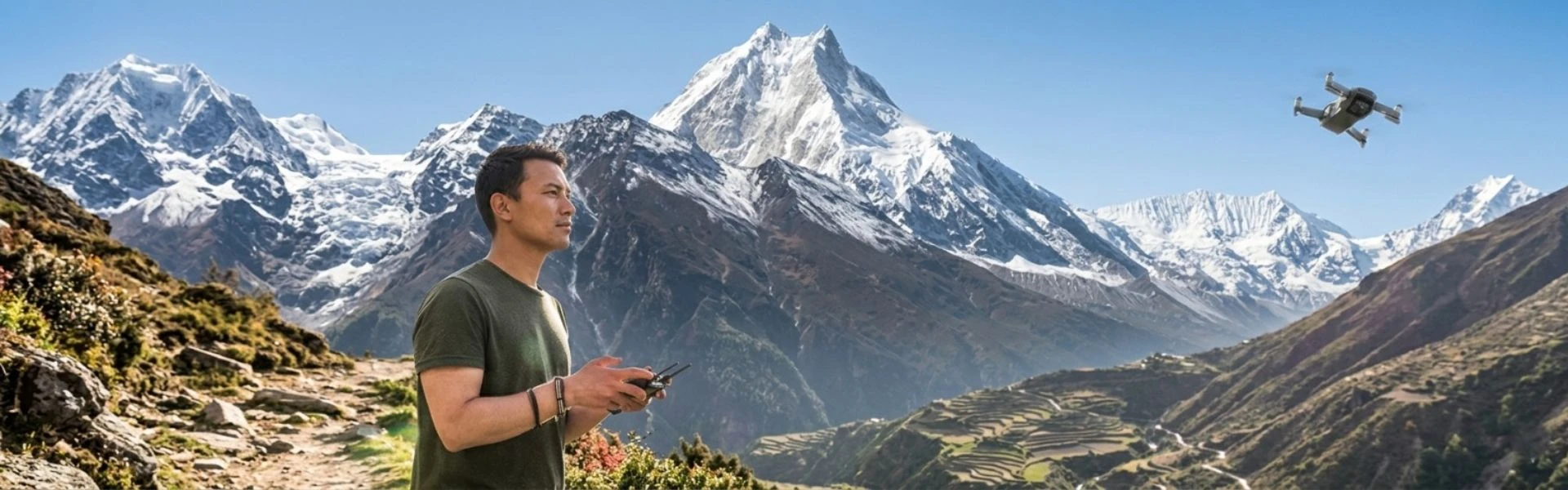
Drone regulations in Nepal are essential to understand before travelling. Drones have become a popular tool for travellers who want to document their journeys to Nepal. From the high ridgelines above Namche Bazaar to the terraced hills of Pokhara, the country offers some of the most compelling aerial footage on earth. But Nepal's drone regulations are serious, layered, and actively enforced. If you arrive without understanding the rules, you could lose your equipment at the airport, face drone confiscation in the field, or find yourself dealing with local authorities in a language you do not speak.
This is a practical guide to drone use for international tourists. It draws directly from Nepal's official RPA/Drone Working Procedure 2075, issued by the Ministry of Home Affairs, and covers the full permit process, drone categories, no-fly zones, and what actually happens when things go wrong on the ground. The goal is not to discourage you from bringing a drone. The goal, rather, is to make sure you know exactly what you are getting into before you pack one.
Whether you are planning a personal Everest Base Camp trek or organising a commercial drone shoot in the Annapurna region, the drone regulations in Nepal apply to you. Using drones without proper authorisation, permits, and approval from the Civil Aviation Authority of Nepal (CAAN) is not a grey area. This guide sets out the drone rules, no-fly zones, and permit process clearly so you can make a confident, informed decision before you travel with Nepal Everest Base Camp Co.
Are Drones Allowed in Nepal?
Legal Status for Tourists
Yes, tourists can fly drones in Nepal, but not without permission. Drone use is legal only when the operator has completed registration and obtained the required drone permit from the appropriate authority in Nepal. Flying a drone without a permit is a violation of Nepal's drone law and can result in seizure of your equipment and legal action.
The core legal framework is set out in Nepal's RPA/Drone Working Procedure 2075, which replaced the earlier UAV directive from 2032. This working procedure, together with the broader laws in Nepal governing civil aviation apply to all individuals and organisations, including foreign nationals, who want to operate a drone anywhere in Nepal.
Key Authorities That Control Drone Use
Three government bodies share responsibility for drone regulations in Nepal. Knowing which one handles what will, therefore, save you a great deal of confusion during the permit process.
Local permit approval for most tourist drone flights above 200 feet AGL
The Civil Aviation Authority of Nepal - the primary civil aviation body of Nepal - is the first body you will deal with for registration. However, for actual drone flight permission, most tourists apply through the relevant District Administration Office, which then coordinates with the local civil aviation office if one exists in that district.
The Department of Tourism may also be involved if your activities fall under a trekking or filming permit. In practice, many travellers underestimate how many offices are in the chain and how long coordination between them takes.
Drone Categories in Nepal (Based on Risk and Weight)
Overview of Drone Categories
CAAN classifies all drones by maximum take-off weight. Your drone categories determine what permits you need, how high you can fly a drone, and where restrictions apply most strictly. Understanding the category system is, in fact, the first practical step before applying for any permit.
Category
Weight
Risk Classification
Category A
Up to 250 grams
Very Low Risk
Category B
250 g to 2 kg
Low Risk
Category C
2 kg to 25 kg
Regulated, Low Risk
Category D
Above 25 kg
Regulated, High Risk
Why Drone Category Matters for Permits
Category A and B drones (under 2 kg) have simplified permit pathways in some contexts but still require registration and a valid drone permit for most tourist flights above 200 feet AGL.
Drones weighing more than 2 kg fall under Category C or D. These require full commercial-level authorisation from CAAN and additional approvals from the Ministry of Home Affairs and relevant sector ministries.
A drone weighing less than 2 kg does not automatically exempt you from the rules. The altitude, location, and purpose of the flight all affect what approvals are needed.
The weight of the drone is measured by maximum take-off weight, not the base unit weight. Batteries and attachments count.
Most consumer drones carried by tourists, including popular models in the 250 g to 900 g range, fall under Category A or B. That is the excellent news. The less convenient news is that even these lighter drones still require a drone registration number and a valid flight permit before you launch.
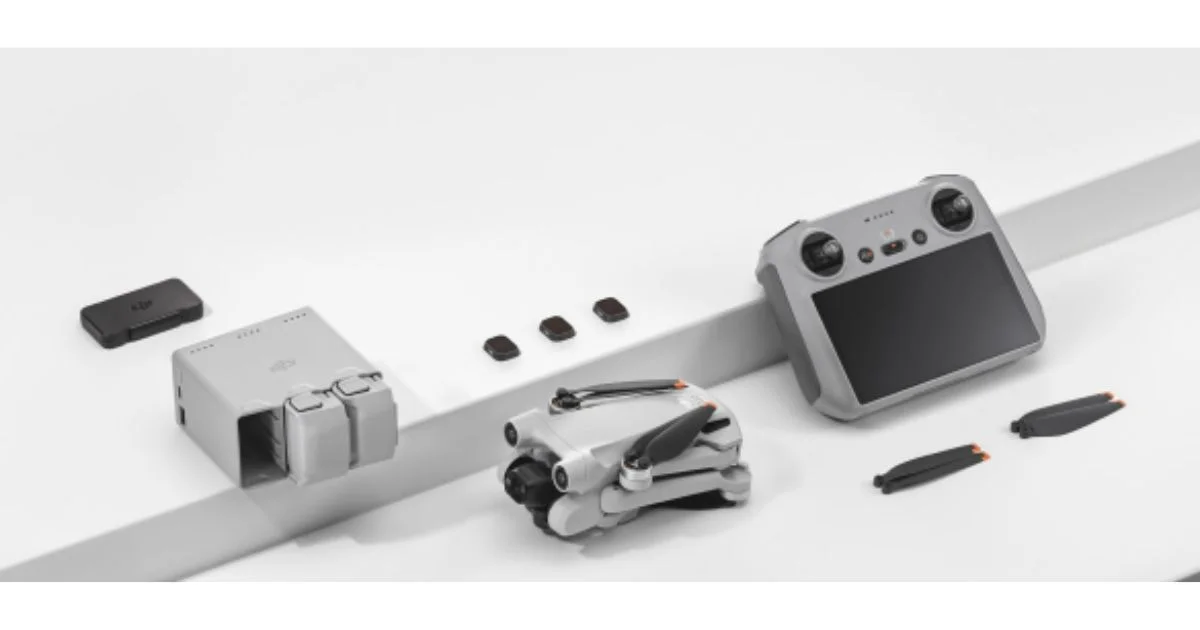
Normal Drone Available in Nepal
Drone Registration in Nepal (UIN Process)
What Is a UIN?
Every drone flown in Nepal must be registered with CAAN. Upon successful registration, the Civil Aviation Authority of Nepal issues a Unique Identification Number (UIN). This number must be affixed to the drone on a secured plate, tag, or SIM before it is flown anywhere in the country.
Drone registration in Nepal is not optional. It applies to all drones, regardless of weight, category, or nationality of the owner. This is, notably, one of the most frequently overlooked steps by first-time visitors arriving in Nepal with a drone.
Who Needs to Register a Drone?
Any individual or organisation intending to fly drones in Nepal, including foreign tourists
The registration applies to the drone unit itself, not the pilot. If you own the drone, you register it.
Commercial operators, film crews, and researchers all fall under the same requirement to register a drone in Nepal before any flight takes place.
Required Documents for Registration
To register your drone with CAAN, you must submit the following:
Copy of passport or citizenship ID (for institutions, a registration certificate of the institution)
Purpose of drone operation (clearly stated)
Technical specifications and a copy of the manufacturer's manual
Purchase invoice (local tax invoice for Nepal-bought drones, or customs invoice for imported units)
After registration, CAAN issues a registration certificate with the UIN. This certificate must accompany the drone at all times during operation.
Where and How to Apply
Registration is handled at the Civil Aviation Authority of Nepal office in Babarmahal, Kathmandu. There is currently no online registration system for foreign nationals. You apply in person, with all documents prepared in advance. Processing times vary. Arriving with incomplete paperwork is, consistently, one of the most common causes of delay.
Drone Permit Process for Tourists (Step-by-Step)
Before You Travel to Nepal
Confirm your drone's category and weight before packing it.
Understand that obtaining a drone permit is not something you can complete online from abroad as a foreign national. You will handle most of it after arrival.
Prepare all documents in advance: passport, visa, drone specs, purchase invoice, and a clear written statement of your intended flight purpose and location. Advance preparation, in particular, significantly reduces the risk of rejection.
Note that the permit issued under the RPA/Drone Working Procedure 2075 is valid from the date of issue and can be extended by up to three months upon application.
After You Arrive in Nepal
The standard process for tourists who want to fly a drone in Nepal works as follows:
Register your drone with CAAN at Babarmahal and obtain your UIN and registration certificate.
Prepare your drone permit application with full flight details, including location, altitude, purpose, and duration.
Submit your application to the relevant District Administration Office (DAO) for the area where you plan to fly your drone.
If flying in a district that has a civil aviation office, the DAO coordinates with that office before issuing approval.
Receive your flight permit and carry it with you at all times during the drone flight.
Authorities You Must Contact
Step
Office
Location
Drone registration
CAAN
Babarmahal, Kathmandu
Flight permit (general areas)
District Administration Office
Relevant district
Flights above 200 ft AGL (Cat A/B)
District Administration Office + CAAN coordination
Relevant district
Sensitive zones
Ministry of Home Affairs
Kathmandu
Approval Timeline and Delays
Standard permit processing at the DAO level typically takes several working days. It is not same-day.
If your flight area falls within a sensitive zone, approvals involve multiple offices, and timelines extend considerably.
The Department of Tourism may also need to be notified if you are operating under a trekking or filming permit in a managed area.
Delays are common. Build this into your itinerary. Travellers who arrive expecting same-week permits often leave without flying at all.
Common Reasons for Rejection
Incomplete documentation at the drone permit application stage
The proposed flight area falls within a no-fly zone or restricted zone
No authorisation letter from a local representative (required for foreign nationals without a local agent)
The flight purpose is listed as 'commercial', but no ministerial recommendation letter is attached
CAAN has not granted frequency clearance for the drone's communication system
Required Documents for Drone Flying
Full Document Checklist
The working procedure specifies what must be submitted when applying for a flight permit. Missing any one of these is enough for the application to be returned.
Document
Notes
CAAN drone registration proof and UIN
Must be completed before applying for flight permit
Flight details and purpose
Include Google Maps or flight location map, dates, area, altitude
Authorisation letter
Required for foreign nationals; must name a local individual or agent
Valid visa and passport
For all foreign drone operators
Pilot's commitment to comply with flight conditions
Written and signed
Drone specifications sheet
Manufacturer data, model, weight, frequency
What the Authorisation Letter Means in Practice
Foreign nationals must obtain a drone permit through a local authorised representative. This is not just a formality. The authorisation letter formally names a local individual or Nepali entity who accepts responsibility for the drone operation. In practice, many touring companies and trekking agencies in Kathmandu offer this service for a fee. If you plan to fly a drone in Nepal without a local agent, the permit application process becomes significantly harder.
Where You Can and Cannot Fly a Drone in Nepal
No-Fly Zones (Strictly Prohibited)
Nepal's working procedure designates several categories of restricted areas for flying drones. Flying drones over or within these zones without explicit special permission is prohibited, and enforcement is real. Additionally, current drone technology does not override physical boundaries. Even GPS-restricted flight modes on consumer drones may not reflect Nepal's full list of controlled zones.
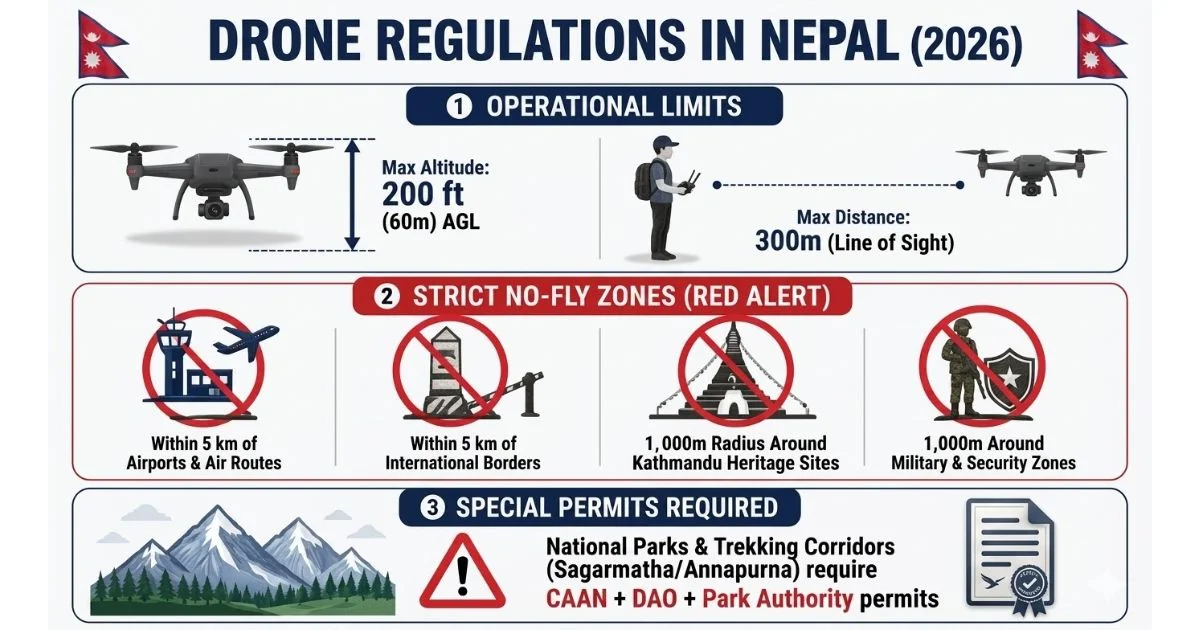
Airports and air routes: No drone flight within 5 km of any airport or along secured air corridors
International borders: No flight within 5 km horizontal distance of any international boundary
Kathmandu Valley heritage and religious sites: Maitidevi, Swayambhunath, Pashupatinath, Bouddhanath, Budhanilkantha, Durbar Square areas in Nepal (Bhaktapur, Patan, and Kathmandu) and the Singha Durbar complex. A 1,000-metre aerial radius restriction applies around these sites.
Military and security zones: No flight within 1,000 metres of military headquarters or training centres, or within 500 metres of other security installations
Environmentally and biologically protected areas: Includes national park zones, wildlife reserves, and areas with significant geological resources
Active security operation zones
Areas designated by federal, provincial, or local government at any time
Restricted Areas Requiring Special Permission
These are areas where a drone flight may be possible but requires direct authorisation beyond the standard District Administration Office permit:
Government buildings, diplomatic missions, hospitals, and religious or cultural sites of significance beyond the standard list
Dense populated settlements
Protected or reserved zones outside the standard no-fly list
Areas Where Drone Flying Is Generally Allowed
Generally, open areas away from the zones listed above, including remote, uninhabited terrain, are accessible for permitted drone flights. "Generally allowed" does not, however, imply permit-free. The working procedure is clear: all drone flying requires either registration-only status (for very specific low-altitude academic use cases) or a valid flight permit.
Drone Use in Trekking Regions (Everest, Annapurna, Etc.)
This is where it gets complicated for most tourists. The regulations to ensure safe and lawful drone operation in Nepal's sensitive trekking corridors involve several overlapping authorities, not just one.
The Everest and Annapurna trekking regions in Nepal sit within or adjacent to national park boundaries. Sagarmatha National Park covers the Everest corridor. Annapurna Conservation Area has its own management rules.
Flying a drone in Nepal's national park areas without explicit permission from the park authority and the relevant DAO is not permitted.
The regulations outlined by CAAN do not override national park rules. You may need separate permission from the Department of Tourism and the national park authority, in addition to your CAAN registration and DAO permit.
For the Everest region, the practical reality is that most trekkers who attempt to fly a drone while trekking without proper permits are stopped at checkpoints or by local staff along the trail. Drones are noticeable, and enforcement in high-traffic trekking corridors has increased considerably.
A permit from the local police or local administration may also be required, depending on the specific area and current local instructions.
Rules You Must Follow While Flying
Maximum Altitude and Distance Limits
The working procedure sets clear operational limits for all drone operations in Nepal. These are not suggestions. Authorities can and do check flight logs.
Rule
Limit
Maximum altitude (Category A/B without special permit)
200 feet AGL (Above Ground Level)
Maximum horizontal range from operator
300 metres
Maximum altitude for recreational use (Cat A only)
For drone operations above 200 feet AGL, even for category A and B drones, you require authorisation from CAAN and the relevant District Administration Office. This requirement is, specifically, a point many travellers miss. The assumption that small, light drones fly freely is incorrect under Nepal's framework.
Daylight and Weather Restrictions
Rules for flying in Nepal include strict environmental conditions. A drone flight is only permitted when all of the following apply:
Daylight hours only (sunrise to sunset)
Ground visibility of at least 5 kilometres
Cloud ceiling of at least 450 metres minimum
Surface wind speed not exceeding 10 knots
No rain, snow, hail, or frost conditions
Flying outside these conditions is a violation, regardless of whether the pilot holds a valid permit.
Visual Line of Sight Requirement
All drone pilots in Nepal must maintain direct visual contact with their drone at all times during flight.
Autonomous or pre-programmed flight modes are restricted. Fully autonomous drones are prohibited from operation in Nepal, in line with ICAO guidance on automated aircraft.
Radio transmission-based remote control is the standard permitted method. Operating the drone via FPV goggles alone, without a visual observer, does not meet the visual line of sight requirement.
Safety and Privacy Rules
The working procedure is explicit on several points that directly affect tourists:
Drone photography or filming that breaches individual privacy rights is prohibited. This includes footage of private residences, individuals without consent, and areas where privacy expectations are reasonable.
You cannot carry your drone across sensitive security zones even as luggage if it is not registered.
Drones must not be used to transport any dangerous item, explosive, biological weapon, animal, or person.
Data collected by the drone, including footage and telemetry, must not be shared with security agencies without following the prescribed legal process.
Flight permits are non-transferable. Only the named pilot in the permit is authorised to fly the drone.
Infography: Regulation of drone flying
Recreational vs Commercial Drone Use
Personal Travel Filming
Personal travel footage, including material intended for personal use, social media, or non-monetised documentation, generally falls under recreational use. For recreational operators in Category A (under 250 g), flying below 50 feet AGL on private property or in open areas with preliminary permission for drone operations from local police may be possible without a full DAO permit, provided the pilot complies with all other rules and regulations. This exception is limited, though, because it does not cover any sensitive or restricted areas.
Practically speaking, if you plan to use a drone at any trekking destination, village, or scenic overlook in a managed area, assume you need a permit. The informal exemption is designed for backyard use, not trekking trail use.
YouTube and Social Media Use
This is a real grey area. If footage is uploaded to YouTube with monetisation enabled, or if you are a content creator whose social media activity generates income, CAAN and permit offices may classify your activity as commercial. There is no formal threshold defined in the working procedure, but declaring your purpose inaccurately on a permit application is a legal risk. Be honest, therefore, about how the footage will be used.
Professional and Commercial Shoots
Commercial drone operations in Nepal are held to a higher standard across the board.
Drones weighing more than 2 kg (Category C and D) used commercially require authorisation from CAAN, a ministerial recommendation letter from the relevant sector ministry, and insurance documentation.
For all commercial operations, a formal drone operator must be named and carry full safety and operational responsibility.
Qualifications for a drone pilot must include proven technical expertise in radio frequency operation, flight control systems, airspace sensitivity, and emergency protocols.
CAAN has the authority to evaluate and test commercial drone pilots before approving commercial operations.
Penalties and Legal Consequences
Fines and Confiscation
The working procedure specifies that violations of its provisions are prosecuted under the Civil Aviation Authority of Nepal Act 2053 and the Electronic Transactions Act 2063. Specific penalties include:
Immediate seizure of the drone by any authorised officer who finds a drone being flown without a permit
Confiscated drones are logged, held, and sent to CAAN along with a police report. CAAN may then auction the drone and transfer proceeds to government revenue accounts.
The issuing authority can seize your drone if it determines the pilot has violated any condition attached to the flight permit, not only if they are flying without one.
Legal Action and Enforcement
Penalties for violating drone regulations include potential legal proceedings under relevant Nepal statutes.
Victims of privacy breaches caused by drone filming may file complaints directly under applicable law, and enforcement follows.
Violating drone rules near security or military zones can result in more serious consequences than simple confiscation.
Authorities can stop, inspect, and confiscate your drone mid-flight if they have grounds to believe the operator is not compliant. This is explicitly provided for under the monitoring and follow-up provisions of the working procedure.
Real Risks Tourists Face
Many tourists carry drones through Tribhuvan International Airport without declaring them. CAAN and customs staff are increasingly aware of common consumer drone models. Carry your drone openly and declare it.
Once a permit is denied, reapplying takes additional time and does not guarantee approval on the second attempt.
In the Everest region, checkpoints along the Sagarmatha National Park trail do ask about drones. Showing the drone flight route on a map and producing a valid permit is the expected response. Not having one leads to confiscation on the spot.
The region showing the drone flight area must match the permit exactly. Flying in an area not listed in your permit is treated as flying without a permit.
Should You Bring a Drone to Nepal?
Pros and Cons
Consideration
Detail
The footage potential
Genuinely exceptional. Mountain scale and terrain variety are hard to replicate anywhere else.
The permit complexity
Multiple offices, days of processing, and real risk of rejection without local support
Enforcement risk
Higher in popular trekking areas and Kathmandu Valley than in remote open terrain
Equipment risk
Altitude, cold, and wind affect battery performance significantly above 3,500 m
Local operator alternative
Licensed operators with existing permits can legally film on your behalf
When It Makes Sense
You have allowed 7 to 10 additional days for the registration and permit process before your trek begins.
You have engaged a Kathmandu-based trekking or production company that can provide an authorisation letter and assist with the DAO application.
Your planned flight locations are away from national park cores, heritage zones, and military areas.
Your drone weighs less than 2 kg, falls under Category A or B, and is already registered with a UIN from a previous Nepal visit or through a pre-arranged process.
When It Is Not Worth It
You are on a tight itinerary with no buffer for permit delays.
You plan to fly a drone in Nepal's national park areas, like Sagarmatha or Annapurna, without a dedicated production permit and national park authority clearance.
Your drone is considered a professional-grade unit (Category C or D), and you have not arranged the full commercial permit process in advance.
Your main purpose is casual documentation rather than dedicated aerial content creation.
Practical Tips for Travellers
Easier Alternatives to Drone Filming
Many licensed drone operators in Kathmandu and Pokhara hold existing permissions for standard filming areas. Hiring one for a day costs less than most people expect and removes all permit risk from your side.
Long-lens photography from ridgelines often produces images comparable to low-altitude drone shots without any regulatory burden.
Some trekking agencies include aerial footage as part of guided documentation packages, handled by operators who already hold the right permits.
Hiring Licensed Drone Operators
If you plan to use the drone footage commercially, partnering with a local licensed drone operator is not just convenient. It is, in fact, the correct legal route. A qualified local drone operator:
Holds a valid registration certificate and UIN for their equipment
Has an established relationship with the relevant DAOs and understands local drone rules
Carries the necessary insurance and ministry recommendation letters for commercial work
Can move forward with the drone permit process far faster than a foreign national applying independently
The Department of Tourism can provide referrals to registered operators, and most established Kathmandu trekking agencies can make introductions.
Staying Compliant While Trekking
Always carry printed copies of your UIN registration, registration certificate, and flight permit. Digital copies are less reliable at remote checkpoints.
Notify the local administration or get a permit from the local police station when entering a new district with your drone, even if your permit covers the area.
Check whether the national park or conservation area you are entering has issued any additional local restrictions. These can change seasonally and are not always reflected in the central permit system.
Do not launch your drone at a trailhead, teahouse courtyard, or popular viewpoint without first checking the zone classification. Even open-looking areas in Nepal can fall within a restricted aerial zone for drones.
Nepal's drone regulations apply at all altitudes above the ground, not just above a fixed height. A drone hovering two metres off the ground at Pashupatinath is still subject to the no-fly rules.
Responsible drone use means being visible and transparent with locals and other trekkers. If anyone asks about your permit, produce it. If you do not have one, land immediately.
Drone Regulations in Nepal: Final Verdict
Drone regulations in Nepal are well-defined on paper, but they are multi-layered in practice. The Civil Aviation Authority of Nepal manages registration and technical approvals. The Ministry of Home Affairs sets the broader regulatory framework. District administration offices handle most on-the-ground permit decisions. National park authorities add their own layer on top of all of that. Understanding the responsibilities and order of each body is crucial. The other half is giving yourself enough time to actually complete the process before your trek begins.
The rules and laws in Nepal related to drone operations are not unusually harsh by international standards. What makes them challenging for tourists is the in-person, paper-based nature of the process and the number of offices involved. If you treat the permit process the way you would treat a trekking permit or a climbing expedition permit - with advance planning, proper documentation, and realistic timelines - it is manageable. What tends to go wrong is when travellers assume the process is simple or that small, recreational drones are exempt. Understanding drone law in Nepal ahead of time, rather than upon arrival, is what separates travellers who get a drone permit successfully from those who do not.
For most casual travellers, the honest advice is this: weigh the footage value against the permit effort and equipment risk, and consider whether a licensed local drone operator might serve your goals better. If the drone rules and laws governing your specific itinerary do not present an obstacle, and you have the time to move forward with the drone permit process properly, Nepal rewards the effort. The drone flight opportunities here are unlike almost anywhere else in the world. The framework exists to protect that environment, not to shut it down entirely. Work within it, and you will be fine. For guidance and support, contact us at Nepal Everest Base Camp Co.
Note: This content is based on Nepal's official RPA/Drone Working Procedure 2075, issued by the Ministry of Home Affairs. Nepal drone regulations and drone rules in Nepal may be updated by relevant authorities. Always verify current requirements with CAAN or your local permit office before you travel.
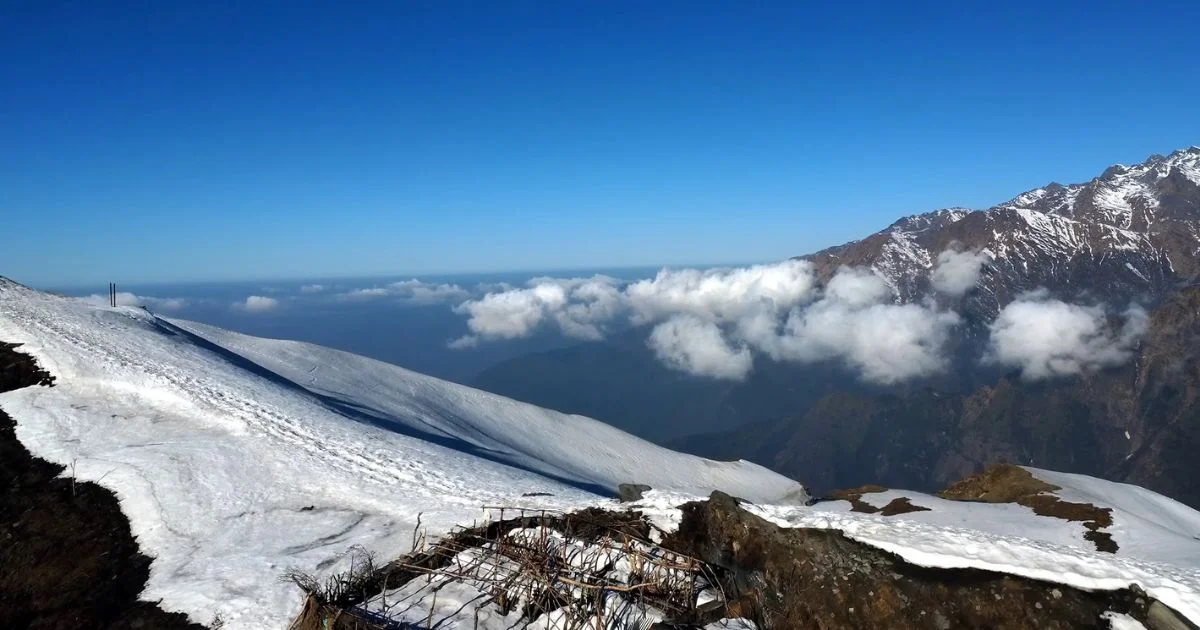
Drone View of Mardi himal view points
Drone Regulations in Nepal: FAQs
Can tourists bring drones into Nepal?
Yes, tourists can carry their drone into Nepal, but they must declare it at customs and register their drone with CAAN before any flight. Undeclared or unregistered drones risk confiscation at the airport or at trekking checkpoints.
Does using a drone in Nepal require permission?
Yes. All operators must obtain a drone permit from the relevant District Administration Office, coordinated with CAAN. Registration with CAAN and a valid UIN are required before the drone permit application can be submitted.
Can I fly a drone at Everest Base Camp?
Flying a drone while trekking the Everest corridor requires permits from both the District Administration Office and the Sagarmatha National Park authority. The Everest region showing the drone flight path on a valid permit is a checkpoint requirement. Without documentation, your drone will be confiscated.
How long does drone approval take in Nepal?
There is no fixed processing time, but most travellers should allow at least five to ten working days for registration and permit approval. Applications involving sensitive zones, commercial purposes, or heavy drones take longer. The permit is then valid for the duration specified, extendable by up to three months.
What happens if I fly a drone without permission?
Flying a drone without a valid permit is a legal violation under drone law in Nepal. Authorities can immediately seize your drone, log it with a police report, and send it to CAAN for processing. Further legal action under the Civil Aviation Authority of Nepal Act 2053 may follow. The seizure of your drone is not contingent on a warning. Enforcement officers can act immediately upon finding an unpermitted flight in progress.
Does drone weight affect the permit process?
Yes. The weight of the drone determines its category under Nepal drone regulations. A drone weighing less than 2 kg falls under Category A or B with a relatively simpler permit pathway. Drones weighing more than 2 kg fall under Category C or D and face significantly more stringent civil aviation regulations, including ministerial letters and CAAN-level technical review. All categories still require registration and a valid flight permit regardless of weight.
Do I need a separate drone permit in Nepal for each district I trek through?
Yes, in most cases. Your drone permit in Nepal is issued by the District Administration Office of a specific district and covers the flight area listed in your application. If you fly your drone across multiple districts during a trek, you may need separate permits for each. Accordingly, plan your permit applications around your full itinerary, not just your primary destination.
Blending digital strategy with mountain passion, I help adventurers find their way to the Himalayas online. With hands-on experience in Nepal’s trekking trails and a role at Nepal Everest Base Camp Trekking Co., Thamel, I combine SEO expertise with true trail insight.