Every climber who attempts to reach Everest's summit passes through one place that stops even the most experienced mountaineers in their tracks. The Khumbu Icefall sits at the base of Mount Everest, creaking and shifting every hour of every day. It is not just a physical barrier. It is the section of the climb where the mountain decides who moves forward and who turns back.
Nepal draws hundreds of thousands of trekkers each year, and most come for the Everest region. Trekkers walk to Everest Base Camp and look up in awe at the frozen chaos above. Climbers, however, must walk into it. The Khumbu Icefall sits between EBC and the upper mountain, and there is no route around it on the southern side.
This guide covers everything you need to understand about the Khumbu Icefall. From its geology and physical features to the risks climbers face, the role of the Icefall Doctors, and the history of tragedy that has shaped modern Everest expedition safety, this article gives you the full picture, whether you are trekking to Everest Base Camp or following an expedition from home. If you are planning your journey, Nepal Everest Base Camp Pvt. Ltd can help you experience the Everest region with experienced local guides and well-organised trekking support.
Everest base camp
Understanding the Khumbu Icefall
What Is the Khumbu Icefall?
The Khumbu Icefall is a section of the Khumbu Glacier where the ice descends rapidly over a steep, uneven rock shelf. When a glacier moves over terrain that drops sharply, the ice cracks, fractures, and buckles under its own weight. The result is a chaotic field of broken ice, tilted blocks, and unstable towers. That is exactly what the Khumbu Icefall is. A slow-motion collapse, frozen mid-fall, and constantly in motion.
The difference between the Khumbu Glacier and the foot of the icefall matters here. The glacier is the broader body of compressed ice that flows from the upper slopes of Mount Everest and surrounding peaks. The icefall, however, is the turbulent lower section where that flow accelerates and breaks apart. Think of a river hitting a waterfall. The calm water above becomes violent white water as it drops. The Khumbu Glacier behaves the same way in ice form.
Where Is the Khumbu Icefall Located?
The Khumbu Icefall sits directly above Everest Base Camp, on the South Col route between Base Camp and Camp 1 of Mount Everest. It begins at roughly 5,400 metres and rises to about 5,943 metres, where it opens into the Western Cwm. This constantly shifting glacier forms the link between Everest Base Camp and Camp 1, making it the first major obstacle every Mount Everest climber must cross on the standard southern route.
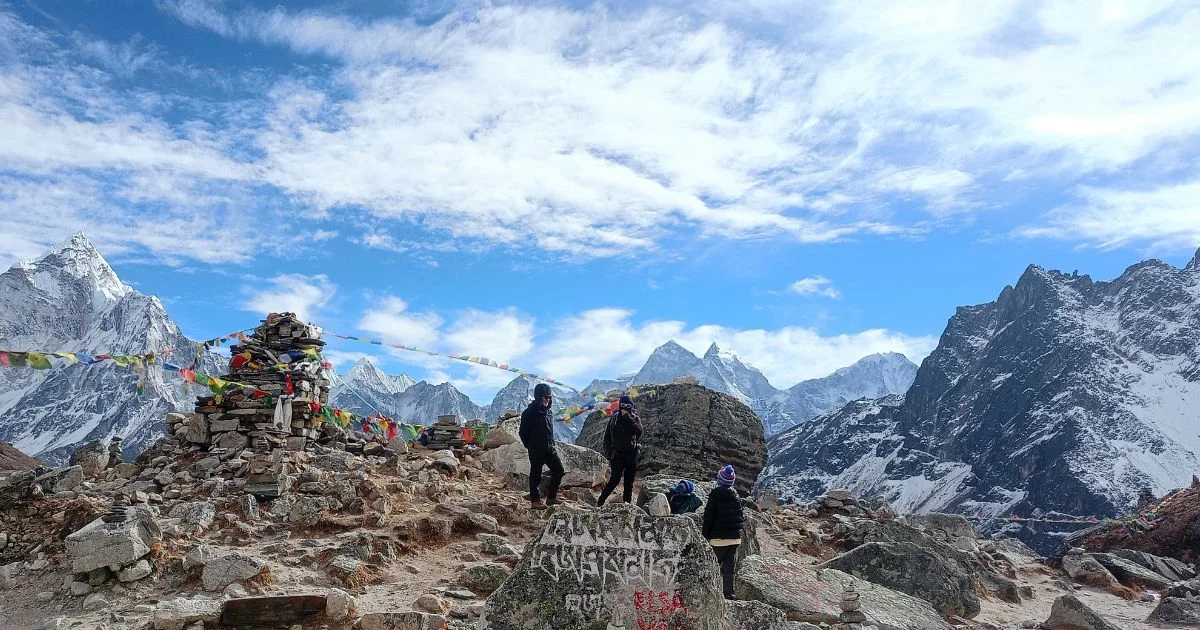
The approach from Everest Base Camp places climbers at the base of the icefall within minutes of leaving camp. There is no gradual warm-up. The danger begins almost immediately. Lobuche village and Gorak Shep are the last villages trekkers pass before reaching EBC, and from Kala Patthar near Pumori, you can see the icefall clearly from a safe distance.
Geological Structure of the Icefall
The Khumbu Glacier moves roughly one metre per day through the icefall zone. That rate is considerably faster than most glaciers because of the steep angle of the terrain. As the ice shifts, it pulls apart in some areas and compresses in others. The result is a constantly changing ice structure that never looks the same from one week to the next.
Crevasses form where the ice is pulled apart by tension. Seracs, which are large towers and blocks of ice, form where the ice buckles upward under pressure. Both can appear, shift, or collapse with little warning. Consequently, the Khumbu Glacier behaves like a slow river of ice, but even slow movement becomes dangerous when the ice weighs millions of tonnes.
Physical Features of the Khumbu Icefall
Massive Seracs and Ice Towers
Towering ice seracs are the most visible feature of the Khumbu Icefall. Some of these structures stand taller than a five-storey building. Each one is a block of ice under enormous internal pressure. They are not static. They lean, crack, and eventually fall, often without any warning sound that gives climbers time to react.
The structures called seracs can weigh thousands of tonnes. A serac collapse sends ice debris across a wide area at tremendous speed. Even acclimatized climbers with years of experience know there is no safe response once a serac begins to fall. Therefore, the only real strategy is to minimize time in the most exposed zones.
Seracs form when ice is compressed and forced upward
They can reach heights of over 15 metres
A falling serac can trigger a secondary avalanche
They are most unstable in the warmest hours of the day
Deep Crevasses and Snow Bridges
Deep crevasses cut through the icefall in every direction. Some are narrow enough to step across. Others drop 30 to 50 metres into blue-black darkness. The problem is that snow bridges, thin crusts of frozen snow that form across the top of a crevasse, can look solid from above while being hollow underneath.
Climbers test every snow bridge before crossing. Even so, a bridge that holds one person may give way under the weight of a second. As a result, many of the ladder crossings in the Khumbu Icefall exist precisely because the crevasses below are too wide or too deep to cross on snow alone.
Feature
Description
Risk Level
Deep crevasses
Vertical splits in the glacier ice
Extreme
Snow bridges
Thin ice spans over crevasses
High
Seracs
Tall, unstable ice towers
Extreme
Ice towers
Smaller compressed ice formations
Moderate to High
Avalanche zones
Areas below Nuptse and Everest walls
Extreme
Mountain View during the Everest Trek
Avalanche Zones Around the Icefall
The Khumbu Icefall sits in a natural bowl surrounded by the walls of Mount Everest, MountLhotse, and Nuptse. All three shed ice and snow onto the icefall below. An avalanche from Nuptse is particularly dangerous because it can cover the icefall quickly and without much warning from below.
The 2014 avalanche that killed 16 Sherpas came from a serac high on the shoulder of Everest. It was not triggered by weather or human activity. It simply fell, as seracs do, because ice and snow under compression eventually give way. That disaster reshaped how the mountaineering community thinks about icefall safety.
A similar reminder came during the April 2026 Everest climbing season, when an icefall collapse damaged sections of the established climbing route through the Khumbu Icefall. The incident forced route repairs and temporary delays while the icefall doctors secured a safe passage for climbers. Although no major weather event triggered the collapse, it highlighted once again that the Khumbu Glacier is constantly moving, and even well-maintained routes can change without warning during the climbing season.
Why the Khumbu Icefall Is So Dangerous
The icefall is regarded as one of the most dangerous sections of any climb in the world. It earns that reputation for several reasons that stack on top of each other.
Falling Ice and Collapsing Seracs
A serac collapse can happen at any time of day or night. The larger seracs in the upper Khumbu Icefall are the biggest single threat to climbers on the route. When one falls, the debris field can cover hundreds of metres in seconds. There is no reliable warning system. There is no shelter. Climbers in the area at the time either survive by chance or they do not.
Hidden Crevasses and Ladder Crossings
Crevasses are the second constant threat. Even well-marked routes can hide new crevasses that opened overnight as the glacier moves. Climbers must pay close attention to every step. The ropes and ladders that Icefall Doctors install each season mark the route, but the ground beneath those ropes changes regularly.
Ladder crossings over wide crevasses are one of the defining experiences of the Khumbu Icefall. A typical crossing involves walking across one or two aluminium ladders tied together with rope over a gap that may drop 40 metres straight down. The ladders flex with each step. Climbers use crampons on metal rungs while wearing a heavy pack, clipped to a fixed rope on either side.
Why Climbers Cross the Icefall Before Sunrise
The most dangerous time in the Khumbu Icefall is midday. As temperatures rise, the ice softens and seracs become more likely to collapse. Moreover, most expedition teams time their crossings to pass through the most exposed zones before the sun reaches them. Climbers typically leave Everest Base Camp between midnight and 2 a.m. to cross the icefall while temperatures are still deeply cold and the ice is at its most stable.
The time to cross the Khumbu Icefall from base camp to Camp 1 is roughly 10–12 hours for a first crossing. Acclimatised climbers who know the route well can move faster, but speed should never come at the cost of attention. The route from Everest Base Camp to Camp 1 gains nearly 600 metres of elevation over some of the most unpredictable terrain on the mountain.
Hazard Summary Table
Hazard
Cause
Frequency
Serac collapse
Ice compression and gravity
Unpredictable
Crevasse falls
Hidden openings in glacier surface
Common risk
Avalanche
Ice and snow release from upper walls
Seasonal
Ladder failure
Equipment wear on moving ice
Low but present
Altitude illness
High-altitude oxygen deficit
Very common
Climbing Through the Khumbu Icefall
How Climbers Navigate the Icefall
Climbers cross the Khumbu Icefall using a system of fixed ropes and aluminium ladders installed before each climbing season. The route is not permanent. Because the Khumbu Glacier shifts every day, the rope lines and ladder placements must be adjusted regularly. A route that was safe three days ago may have a new crevasse running through it today.
Climbers clip into the fixed ropes using a jumar, a mechanical device that slides upward but locks when pulled downward. This gives some protection on steep sections, though it offers little help if a serac collapses nearby. Overall, the rope system is more about guiding the route and providing safety to the travellers.
Ropes and ladders work together across the Khumbu Icefall:
Fixed ropes mark the route and assist movement on steep ice
Aluminium ladders bridge crevasses too wide to jump
Multiple ladders are often lashed together for longer crossings
Rope anchors are drilled into the ice and replaced as the glacier moves
Who Are the Icefall Doctors?
The Icefall Doctors are a team of Sherpas employed by the Sagarmatha Pollution Control Committee to prepare and maintain the route through the Khumbu Icefall each spring. They begin work weeks before the main climbing season starts, fixing ropes, installing ladders, and marking the safest path through the ice.
Their job does not end when climbers arrive. The Icefall Doctors monitor the route throughout the season, replacing ropes that have been cut by moving ice, resetting ladder crossings over new crevasses, and assessing which sections have become too dangerous to use. They are, by any measure, among the most skilled and courageous workers in Himalayan mountaineering.
The risks they face are the same risks they help others manage. Icefall Doctors spend more time in the Khumbu Icefall than anyone else during an expedition season. Numerous people have been killed or seriously injured while doing their jobs. Despite this, experienced teams return each year, guided by a mix of professional skill, cultural connection to the mountain, and the income that route-fixing provides to Nepali communities.
Camps Connected to the Icefall Route
The Khumbu Icefall sits between two key expedition camps:
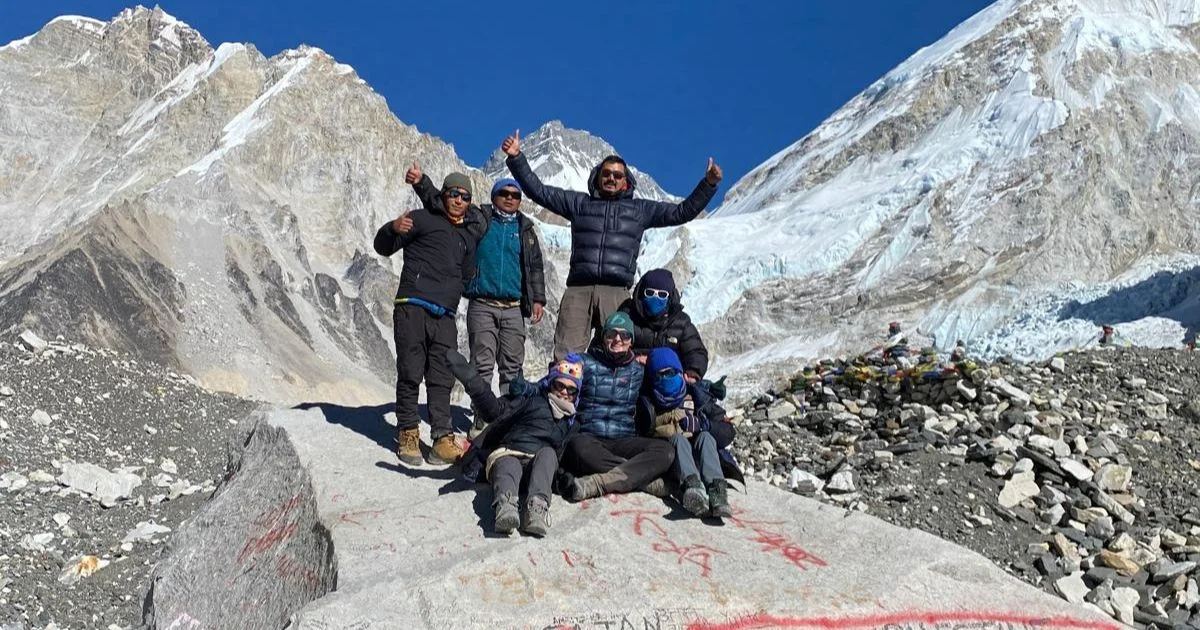
Everest Base Camp (5,364 m): The departure point for all icefall crossings. Prayer flags mark this camp, and every expedition team holds a Puja ceremony here before entering the icefall.
Camp 1 (5,943 m): Positioned at the top of the icefall, at the foot of the Western Cwm. This is where climbers rest and acclimatise before pushing higher.
Camp II and beyond: Found beneath the Lhotse face, deeper within the Western Cwm. Climbers use Camp 1 as a rest stop during rotations to higher camps on the way to Everest's South Col.
History of the Khumbu Icefall
Early Everest Expeditions Through the Icefall
The Khumbu Icefall was first seriously explored by the 1951 British reconnaissance team led by Eric Shipton. That team identified the icefall as a viable but extremely hazardous route into the upper mountain from the Nepalese side. Before that expedition, the southern approach had been largely unexplored because Tibet controlled the northern routes and Nepal had only recently opened its borders.
The 1953 British expedition led by John Hunt became the first to successfully climb Everest using the south col route through the Khumbu Icefall. Hillary and Tenzing Norgay reached the Everest summit on 29 May 1953, but their success depended entirely on the team's ability to establish a safe passage through the icefall. Without the support of a team of Sherpas carrying loads through that zone repeatedly, the upper camps could not have been stocked.
Major Accidents and Tragedies in the Icefall
Deaths in the icefall have been recorded since the earliest expeditions. The Himalayan Database documents over 40 fatalities in the Khumbu Icefall specifically, making it the single most deadly section of the Everest route. Most deaths result from avalanches,serac collapses, or crevasse falls.
The worst single event in Khumbu Icefall history came on April 18, 2014. A massive serac broke free from the shoulder of Everest above the icefall and triggered a large avalanche during a busy morning crossing. The 2014 avalanche killed 16 Sherpas, the highest single-day death toll in Mount Everest history. Six Sherpas were never recovered. Many of those Sherpas died while working as Sherpas, carrying loads to stock higher camps. Consequently, the disaster led to a full cancellation of the 2014 climbing season by most expedition teams.
The 2015 earthquake added another chapter. A 7.8-magnitude earthquake struck Nepal on 25 April 2015, triggering a massive avalanche from the Pumori ridge that swept through Everest Base Camp. At least 22 people died, including several climbers at EBC. The 2015 season was also cancelled. That earthquake accelerated changes in how expedition operators assess risk in the Khumbu region.
By 2021, operators and Sherpas had developed stronger early-warning protocols and route-timing systems, though no technology has yet made crossing the icefall truly safe. Peak climbing in the Everest region has grown each year, and each season, six Sherpas or more are involved in maintaining the fixed ropes that make the route passable at all.
The 2026 Everest climbing season brought another reminder of the Khumbu Icefall's unpredictability when a section of the established climbing route was damaged by shifting ice in April 2026.
The incident demonstrated that conditions on the Khumbu Glacier can change at any time, even during the busiest expedition season, by temporarily stopping crossings until the icefall doctors reconstructed the path with new ladders and fixed ropes.
How Safety Practices Have Changed Over Time
The 1953 era saw no fixed ropes, no aluminium ladders, and no dedicated route-preparation team. Mountaineers used wooden planks, hemp ropes, and improvised crossings that would be considered unacceptable today. Over the following decades, the introduction of ropes and ladders made the crossing safer, but the fundamental risks of serac collapse and avalanche remain unchanged.
Modern expedition teams now require all climbers to wear avalanche beacons in the Khumbu Icefall. Crossing windows are strictly managed to reduce exposure time. After the 2014 avalanche, new agreements between the Nepalese government and Sherpa communities changed compensation and insurance standards for icefall doctors and high-altitude workers. Physical fitness standards for climbers attempting Mount Everest have also become a point of growing discussion, as overcrowding in the Khumbu Icefall itself adds to overall risk.
Climate Change and the Khumbu Icefall
How Global Warming Is Affecting the Khumbu Glacier
More quickly than at any other time in recorded history, the Khumbu Glacier is shedding mass. Research from the International Centre for Integrated Mountain Development, along with satellite studies of the Everest region, shows that Himalayan glaciers are retreating at an accelerating rate. The Khumbu Glacier has thinned significantly since the mid-20th century, and the process is continuing.
Warmer temperatures affect the Khumbu Icefall in ways that make it more dangerous, not less. The ice becomes less stable as the glacier thins. Once held up by surrounding ice, seracs are now more vulnerable. Snow bridges over crevasses form later in the season and melt earlier. This shortens the window during which safe ladder crossings are possible.
Faster Ice Movement and Increasing Instability
As the Khumbu Glacier moves over a warming base layer, the rate of ice flow through the icefall zone increases. Faster movement means more frequent crevasse formation and more rapid shifts in serac positions. What was a stable section of the route in April may be unrecognisable by May.
Scientists monitoring the Everest region have documented increased serac calving on the upper walls above the Khumbu Icefall. Because avalanche events from Nuptse and the shoulder of Everest are linked to ice instability on those walls, warming temperatures indirectly increase the avalanche risk in the icefall below.
Melting Ice and Route Changes
Thinning snow bridges collapse earlier in the season
New deep crevasses appear in sections that were previously solid
The route that Icefall Doctors lay each spring must be rerouted more often
Some traditional crossing points are no longer viable
The overall high-altitude environment of the Khumbu region is changing year on year
The long-term implications for mountaineering on the South Col route are serious. If the glacier continues to thin at the current rate, the Khumbu Icefall will become structurally different from what climbers have navigated for the past 70 years.
On the way to Ebc from Gorakshep
Can Trekkers See the Khumbu Icefall?
Best Places to View the Icefall
Trekkers cannot enter the Khumbu Icefall without the permits and gear required for a full Everestexpedition. However, the icefall is clearly visible from several points along the Everest Base Camp trek, and the views are remarkable.
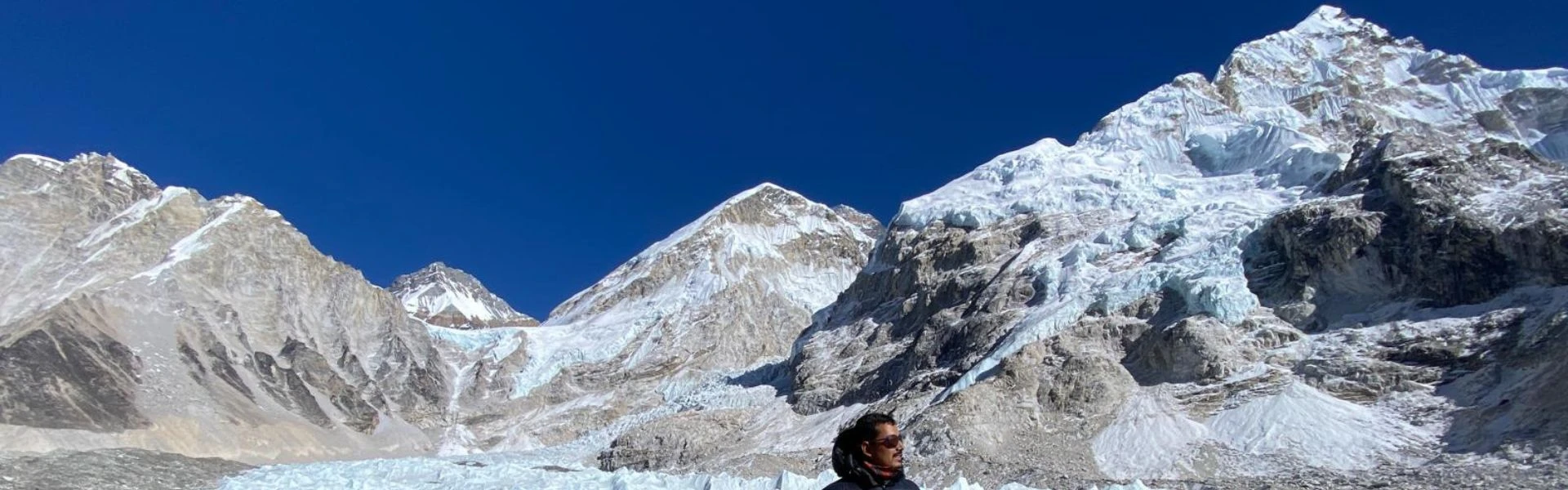
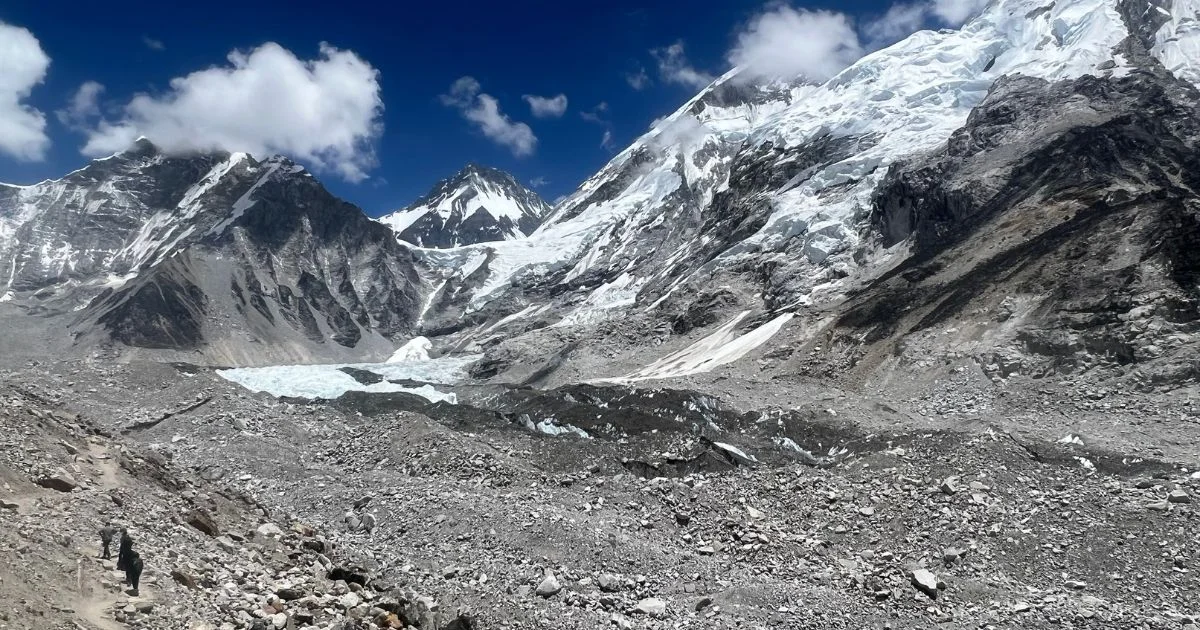
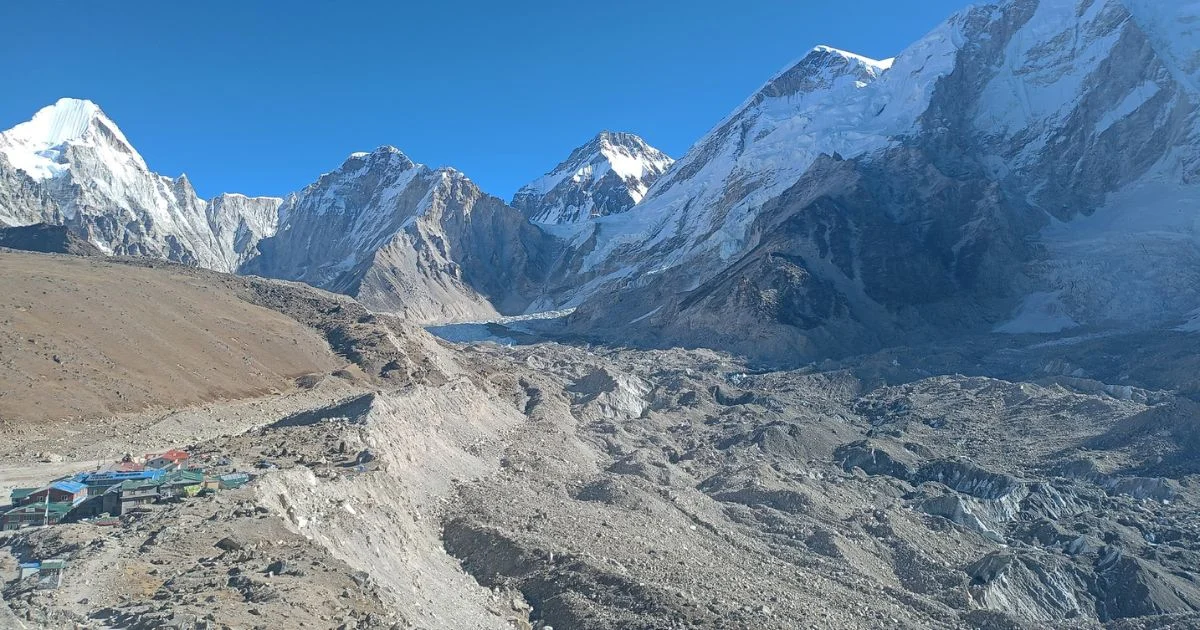
Everest Base Camp itself gives you the closest ground-level view. You can see the lower section of the Khumbu Icefall directly from camp, with ice blocks, ice towers, and the maze of broken glacier stretching upward. Prayer flags line the perimeter of the camp, and on a clear morning, the sounds of the icefall, cracking ice and the groan of the shifting glacier are clearly audible.
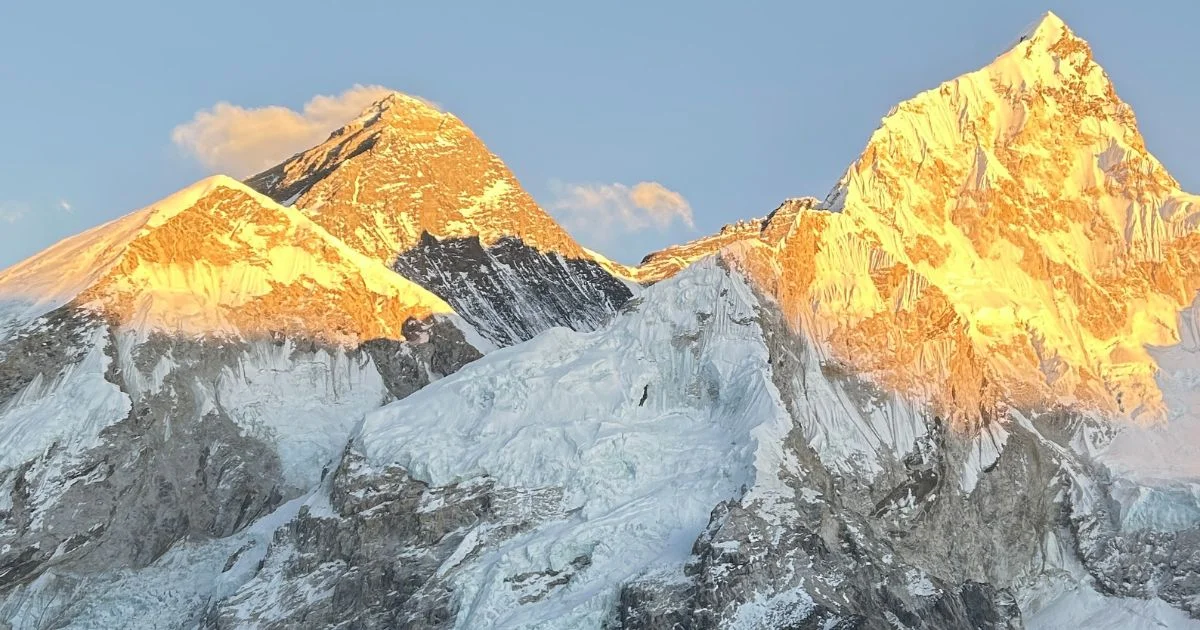
Kala Patthar, at 5,643 metres near Pumori, is the best single viewpoint for the full icefall. From here, trekkers can see the entire Khumbu Icefall in context, from EBC at the base to Camp 1 at the top, with the Western Cwm opening beyond. Most trekkers reach Kala Patthar before dawn to catch the icefall in alpenglow, which is worth the early start.
Gorak Shep, the last village before EBC, also offers partial views of the icefall from its lodge rooftops on a clear day.
Shoot in the early morning when light hits the Khumbu Icefall directly
A telephoto lens of 200mm or longer brings the seracs and ice towers into sharp detail
The climbing season in April and May offers the most visible activity in the icefall
Clear days in late March also give good visibility before the monsoon cloud builds
From Kala Patthar, shoot east at sunrise for the most dramatic natural light on Mount Everest and the icefall below
Mt. Everest view from Kalapatthar
Cultural and Environmental Importance
The Khumbu Region and Sherpa Heritage
The Khumbu Icefall is not just a geographical feature. For Sherpapeople, the mountain and everything on it carries deep spiritual weight. Before any expedition team enters the Khumbu Icefall, a Puja ceremony is held at Everest Base Camp. Lamas bless the climbers and Sherpas, and offerings are made to the mountain. Prayer flags are raised. The ritual asks for permission to enter the mountain's domain.
Sherpas lost their lives in the icefall in numbers far greater than any other group. Because Sherpas carry loads through the icefall more often, acclimatise at this elevation repeatedly, and spend more cumulative hours in the danger zone than foreign climbers, their exposure is disproportionately high. The events of the 2014 avalanche forced a long-overdue conversation about this imbalance.
Environmental Challenges in the Everest Region
Nepal has worked to address the environmental impact of large-scale expedition activity in Sagarmatha National Park. Waste removal, fixed rope management, and human waste disposal are all areas where new rules have been put in place. Furthermore, the Khumbu Icefall itself presents challenges because equipment left in the glacier, old ladders, frayed ropes, and discarded gear get buried and re-emerge years later as the ice moves.
Khumbu Icefall vs Other Dangerous Sections of Everest
Although there are other hazardous areas on Mount Everest, the Khumbu Icefall falls into a different risk category.
Section
Primary Hazard
Controllability
Khumbu Icefall
Serac collapse, avalanche, hidden crevasses
Very low. Objective danger.
Lhotse Face
Steep ice, falling ice, rockfall
Moderate. Fixed ropes help.
Hillary Step
Technical rock and ice climbing
Moderate. Manageable in good conditions.
South Col
Extreme wind, cold, and altitude
Moderate. Weather-dependent.
Balcony
Altitude and exhaustion
Low to moderate. Manageable.
Khumbu Icefall vs Lhotse Face
The Lhotse Face is steep and technically demanding, but its dangers are largely manageable with fixed ropes and good conditions. Climbers on the Lhotse Face can read the terrain clearly. The Khumbu Icefall, however, offers no such clarity. The danger comes from above and from below, often without visible warning.
Khumbu Icefall vs Hillary Step
The Hillary Step, near Everest's south col, is a short but exposed section of technical mountaineering just below the summit. It requires skill and fitness, but the risk is bounded. A climber who falls on the Hillary Step faces a personal consequence. A serac collapse in the Khumbu Icefall, by contrast, can kill an entire rope team at once.
Which Part of Everest Is the Most Dangerous?
The Khumbu Icefall is consistently identified by Himalayanmountaineers and organisations as the single most dangerous section of the climb to the Everest route. The Himalayan Database records support this. More people have died in the Khumbu Icefall than in any other single section of the South Col route. The reason is straightforward. Objective danger from collapsing ice is not something climbers can train or prepare their way out of entirely.
Khumbu Icefall: Final Insights
The Khumbu Icefall is the threshold every climber on the southern route must cross before anything else on Mount Everest becomes possible. It has shaped the history of Himalayanmountaineering more than any other single feature, driven safety innovation, claimed more lives than any other section, and defined what it means to commit fully to an Everest expedition. There is nowhere on the mountain where the line between ambition and survival is drawn more clearly.
For trekkers, the Khumbu Icefall is something you will see and feel without entering. From Everest Base Camp and from Kala Patthar, you will hear the glacier groan and watch the ice towers catch the morning light. That distance is the right distance for most people, and there is nothing small about standing at EBC and looking up at what climbers must walk into. The experience is completely its own.
The Khumbu Icefall will keep moving, keep changing, and keep demanding the highest level of respect from everyone who enters the Khumbu region. Climate change is accelerating its instability. The Sherpa communities who maintain its route and carry its risk deserve far greater recognition than they have historically received. The mountain, as always, makes the final call. If you are planning an Everest Base Camp trek or another adventure in the Everest region, contact Nepal Everest Base Camp Pvt. Ltd for expert guidance, experienced local support, and a safe, well-planned trekking experience.
Khumbu Glacier and khumbu icefall
FAQs About the Khumbu Icefall
What Is the Khumbu Icefall?
The Khumbu Icefall is a highly fractured section of the Khumbu Glacier on the southern face of Mount Everest, located between Everest Base Camp and Camp 1. It forms where the glacier descends steeply over a rock shelf, creating a field of crevasses, seracs, and unstable ice that shifts daily.
Why Is the Khumbu Icefall So Dangerous?
What makes the Khumbu icefall so dangerous is the combination of serac collapse, hidden crevasses, and avalanche risk from the surrounding walls of Everest and Nuptse. These hazards are largely uncontrollable, meaning danger exists regardless of how experienced or well-equipped a climber is.
How Do Climbers Cross the Khumbu Icefall?
Climbers cross the Khumbu Icefall using fixed ropes and aluminium ladders installed each season by the Icefall Doctors. They clip into the rope system for security on steep sections and walk across ladder crossings over deep crevasses, typically starting before sunrise to avoid the most dangerous warming-hour window.
What Are Icefall Doctors?
Icefall doctors are a team of expert Sherpas who prepare and maintain the climbing route through the Khumbu Icefall each spring climbing season. They install ropes and ladders, adjust the route as the glacier moves, and keep the passage open throughout the expedition period.
How Many People Have Died in the Khumbu Icefall?
Deaths in the icefall number over 40 recorded fatalities, according to the Himalayan Database. The worst single event was the 2014 avalanche on April 18, which killed 16 Sherpas in one morning. Most deaths result from serac collapse or avalanche.
How Long Does It Take to Cross the Khumbu Icefall?
The time to cross from Everest Base Camp to Camp 1 is roughly 10–12 hours on a first crossing. Acclimatised climbers familiar with the route can move faster on later rotations, though careful movement remains more important than speed.
Can Trekkers Visit the Khumbu Icefall?
Trekkers cannot enter the Khumbu Icefall without full expedition permits and equipment. However, the icefall is clearly visible from Everest Base Camp and from Kala Patthar, where the entire Khumbu Icefall from the base to Camp 1 is visible on a clear day.
How High Is the Khumbu Icefall?
The Khumbu Icefall rises from approximately 5,400 metres at its base near EBC to around 5,943 metres at Camp 1, at the foot of the Western Cwm. It is part of the highest glacier system in the world on the flanks of Mount Everest.
Does Climate Change Affect the Khumbu Icefall?
Yes. The Khumbu Glacier is thinning and moving faster due to rising temperatures. This makes the Khumbu Icefall more unstable, weakens snow bridges, opens new crevasses earlier in the season, and increases the frequency of serac calving on the walls above.
When Is the Safest Time to Cross the Khumbu Icefall?
The safest time to cross is before sunrise, when cold temperatures stabilise the ice. The main climbing season window of late March to mid-May is when the Icefall Doctors have the route fully prepared. Even so, no crossing of the Khumbu Icefall is without risk.
Blending digital strategy with mountain passion, I help adventurers find their way to the Himalayas online. With hands-on experience in Nepal’s trekking trails and a role at Nepal Everest Base Camp Trekking Co., Thamel, I combine SEO expertise with true trail insight.