Lobuche Peak stands at 6119 meters in the Khumbu region, positioned near Everest Base Camp and representing a significant step into Himalayan mountaineering. Consequently, understanding Lobuche Peak climbing difficulty helps climbers assess whether this peak matches their technical ability, fitness level, and altitude tolerance. This Lobuche Peak in Nepal attracts experienced trekkers transitioning into technical climbing, yet many underestimate the physical and mental demands required above 6000 metres.
The climb combines glacier navigation, fixed rope work, and steep snow slopes where climbing skills directly influence safety and summit success. Furthermore, altitude sickness remains a critical factor, as performance drops sharply above 5800 meters regardless of fitness. Whether you're comparing Lobuche Peak with Island Peak or evaluating your first 6000-meter peak, honest assessment prevents dangerous situations.
This blog article by Nepal Everest Base Camp Co. examines every aspect of Lobuche Peak climbing difficulty, from terrain challenges and acclimatization strategies to logistics, climbing gear, and real climber experiences. Additionally, it provides decision-grade information for those planning a Lobuche Peak climb in 2026 or beyond. By the end, you'll know exactly what this peak expedition demands and whether you're ready.
2. Lobuche Peak Overview
2.1 Location and Peaks (East and West)
Lobuche Peak sits in the Khumbu region of Nepal, approximately 8 kilometres southwest of Mount Everest. The peak consists of two distinct summits: Lobuche East (6119 m) and Lobuche West (6145 m), separated by a technical ridge. Most commercial expeditions target Lobuche East because it's classified as a trekking peak by the Nepal Mountaineering Association, whereas Lobuche West requires a full expedition peak permit.
The geographical position places Lobuche Peak directly on the approach to Everest Base Camp trek, making it accessible through the standard trek route from Lukla. Specifically, Lobuche village serves as the final settlement before establishing base camp, offering tea houses and basic facilities at 4940 metres. The east face presents the normal climbing route, featuring a glacier approach, high camp placement, and summit headwall sections. In contrast to other remote peaks, this accessibility makes logistics considerably more manageable for international climbers.
Distance from Lukla: approximately 65km trekking distance
Proximity to Everest Base Camp: 10km
Lobuche village elevation: 4940m
Subsequently, this strategic location allows climbers to combine Everest Base Camp trekking with a legitimate peak attempt. As a result, the expedition delivers maximum value within limited vacation time.
Lobuche Village
2.2 Trekking Peak vs Expedition Peak
Understanding the classification system clarifies what Lobuche Peak requires in terms of permits and technical preparation. The Nepal Mountaineering Association designates certain peaks as "trekking peaks" based on technical difficulty and accessibility, though this term misleads many climbers. In reality, Lobuche East peak demands genuine mountaineering skills, not just hiking ability.
Lobuche East and Lobuche West illustrate this distinction clearly:
Aspect
Lobuche East (Trekking Peak)
Lobuche West (Expedition Peak)
Permit Cost
$250-400 (NMA)
$1000+ (Government)
Technical Difficulty
Alpine Grade PD+
Alpine Grade AD
Route Complexity
Fixed ropes, moderate ice climbing
Serious ridge traverse
Commercial Availability
Widely offered
Rarely attempted
Climbing Experience Required
Intermediate
Advanced
Consequently, the trekking peak label doesn't reduce difficulty. Rather, it indicates permit accessibility and general route character compared to major Himalayan giants.
2.3 Why People Climb Lobuche Peak
The journey to Lobuche Peak attracts climbers for specific reasons beyond simple summit collection. Primarily, it offers a legitimate 6000-metre peak climbing experience in the Everest region, combining trekking and climbing in one expedition. Moreover, it serves as preparation for higher objectives like Cho Oyu, Manaslu, or even Everest itself.
Primary Motivations:
Training ground for high altitude performance assessment
Technical skill development on real Himalayan terrain
Everest Base Camp integration, experiencing the Khumbu without full expedition cost
Personal achievement, transitioning from trekking to mountaineering
Relatively short timeframe compared to 8000-metre expeditions
Additionally, the climb provides perspective on altitude effects that can't be replicated in lower ranges. Many climbers discover their true tolerance for higher altitude only after spending days above 5500 metres. Therefore, Lobuche Peak functions as both an objective and a testing ground. Ultimately, climbing Lobuche Peak offers practical experience that shapes future expedition choices and reveals personal limits in controlled environments.
3. Defining Climbing Difficulty
3.1 Alpine Grading (PD/AD Explained)
Alpine grading systems measure technical difficulty, exposure, and commitment on mountain climbing routes. The French system uses classifications from F (Facile/Easy) through ED (Extrêmement Difficile/Extremely Difficult). Consequently, Lobuche East receives a PD+ rating (Peu Difficile/Slightly Difficult), though conditions vary significantly.
PD+ Grade Characteristics:
Moderate technical climb with straightforward route finding
Sections requiring crampons, ice axes, and rope work
Some exposure, but manageable with proper climbing skills
Glacier travel with crevasse hazards
Summit slopes up to 45-50 degrees
However, grading doesn't account for altitude effects. A PD+ route at 3000 metres feels completely different from the same technical difficulty at 6000+ metres where oxygen saturation drops below 85 percent. Moreover, Lobuche Peak requires technical climbing skills that must function automatically despite cognitive decline from oxygen deprivation.
3.2 How Difficulty Is Measured on Lobuche Peak
Lobuche Peak climbing difficulty combines multiple factors beyond pure technical climbing. Specifically, performance depends on terrain complexity, altitude, weather conditions, and individual physiology. Therefore, measuring how difficult is Lobuche Peak requires examining each component separately.
Difficulty Components:
Factor
Impact Level
Why It Matters
Technical Skills
Moderate
Fixed ropes reduce exposure, but crampon skills essential
Altitude Effects
High
6119m creates significant performance reduction
Physical Endurance
High
10-14 hour summit days at altitude
Weather Variability
Moderate-High
Khumbu conditions change rapidly
Route Finding
Low-Moderate
Established route, usually Sherpa-supported
Consequently, fitness and altitude tolerance often matter more than raw climbing experience on Lobuche Peak. Many strong technical climbers struggle, while well-acclimatised trekkers succeed, illustrating the unique difficulty level of Himalayan objectives.
3.3 Difficulty vs Other Nepal Peaks
Comparing Lobuche Peak with other popular objectives clarifies where it sits in the difficulty spectrum. Notably, Lobuche vs Island Peak difficulty represents the most common comparison, as both attract similar climber profiles. Additionally, Mera Peak and Yala Peak provide reference points.
Comparative Difficulty (Ranked Easiest to Hardest):
Mera Peak (6476 m) - Less technical, altitude challenge primary
Island Peak (6189 m) - Similar altitude, slightly less steep
Lobuche East (6119 m) - Steeper summit approach, longer summit day
Ama Dablam (6812 m) - Significantly more technical
Mount Cho Oyu (8188m) - Extreme altitude, lower technical difficulty
Therefore, Lobuche Peak sits in the intermediate category, harder than entry-level trekking peaks but accessible to properly prepared climbers with basic climbing skills.
4. Physical and Technical Challenges
4.1 Terrain and Route Overview
The standard route to Lobuche begins from Lobuche village, ascending the Lobuche Glacier to establish Lobuche Base Camp at approximately 4950 metres. From there, the route continues to High Camp at 5400 metres, positioned on rocky moraine or glacier terrain. Finally, the summit push tackles 700+ vertical metres through varied snow and ice terrain. Understanding the route for climbing Lobuche helps climbers prepare mentally and physically for each distinct section.
Route Profile:
Lobuche village to Lobuche Peak Base Camp: 2-3 hours, gradual glacier approach
Base Camp to High Camp: 3-4 hours, steeper moraine and snow slopes
High Camp to summit and return to base camp: 5-7 hours ascent and 4-5 hours descent,hours descent, mixed terrain
Terrain varies from crevassed glacier sections requiring careful navigation to 40-50 degree snow slopes near the summit. Moreover, conditions change seasonally, with post-monsoon routes differing from spring conditions.
4.2 Summit Push: Snow, Ice, Fixed Ropes
The summit day begins around 2-3am from Lobuche High Camp, targeting arrival at the summit of Lobuche Peak by mid-morning before weather deteriorates. Initially, climbers ascend moderate snow slopes in darkness using headlamps. Subsequently, the route steepens significantly, reaching 45-50 degrees on the final summit headwall.
Summit Day Breakdown:
2am-4am: Moderate snow slopes, steady crampon work
4am-6am: Steeper terrain, fixed rope sections begin
6am-8am: Summit headwall, 45-50 degree slope, continuous rope use
8am-9am: Final ridge approach, reach the summit window
9am-1pm: Descent to High Camp, technically demanding when fatigued
The climb includes extended periods on fixed ropes, requiring proper jumar technique and ice climbing skills. Fixed ropes installed by Sherpa teams reduce objective danger, yet proper jumar technique and rope management remain essential. Consequently, climbers unfamiliar with rope ascending struggle significantly, particularly during descent when exhaustion peaks.
4.3 Glacier Travel and Crevasses
Lobuche Peak approach involves substantial glacier travel, presenting crevasse hazards from Base Camp onwards. The Lobuche Glacier contains both obvious and hidden crevasses. requiring proper rope team protocols and vigilance. During the pre-monsoon season, snow bridges remain relatively stable, whereas post-monsoon conditions expose more open crevasses.
Glacier Safety Requirements:
Rope team travel in crevassed sections
Crevasse rescue knowledge for entire team
Probe technique understanding
Route recognition skills
Anchor building for rescue scenarios
Most commercial expeditions provide Sherpa support for route finding and safety, yet understanding these hazards prevents complacency. Additionally, solo or unsupported attempts face substantially higher altitude risk due to rescue limitations.
4.4 Key Technical Sections and Skills Required
Climbing Lobuche Peak requires proficiency in several technical climbing skills, though none at advanced levels. Primarily, competent crampon use on slopes up to 50 degrees forms the foundation. Additionally, fixed rope ascending and descending with mechanical ascenders (jumars) sees constant use above High Camp.
Essential Skills Checklist:
Crampon technique: French technique (front-pointing) on steep sections
Ice axe arrest and support techniques
Jumar/ascender use on fixed ropes
Rappel/abseil descent on fixed lines
Rope team glacier travel
Basic climbing anchor assessment
Cold-weather climbing equipment operation
Importantly, these skills must function at altitude, where cognitive ability declines. Practising at sea level provides a foundation, but performance drops 30-40 percent above 6000 metres. Therefore, skills should be second nature before attempting Lobuche East peak climbing. Mastering what's required for Lobuche Peak means practising until movements become automatic, even when oxygen-deprived and exhausted.
Lobuche base camp
5. Altitude and Acclimatization
5.1 Altitude Effects on the Body
Altitude represents the single largest difficulty factor on Lobuche Peak, regardless of climbing experience or fitness level. At 6119 metres, atmospheric pressure drops to roughly 50 percent of sea level, reducing oxygen availability proportionally. Consequently, every physical action requires substantially more effort than identical movements at lower elevations. In other words, what feels easy at sea level becomes exhausting at extreme altitude.
Physiological Changes at 6000+ Metres:
Oxygen saturation: typically 80-90 percent (vs 95-100 percent at sea level)
Heart rate: increases 20-40 beats per minute at rest
Breathing rate: doubles or triples during exertion
Cognitive function: declines 20-30 percent
Sleep quality: significantly degraded
Appetite: often suppressed
These effects accumulate over multi-day expeditions. Even well-acclimatised climbers experience performance reduction, making the climb substantially harder than equivalent terrain at lower altitude. Additionally, individual responses vary dramatically, with some people naturally tolerating high altitude better than others. Therefore, predicting personal response proves difficult without prior experience above 5500 metres. Nevertheless, proper acclimatization protocols reduce severity significantly even when genetic tolerance remains average.
5.2 Altitude Sickness Risks
Altitude sickness occurs when ascent outpaces the body's acclimatization capacity. On Lobuche Peak expeditions, the risk of altitude sickness increases from Namche Bazaar (3440 m) onwards. Specifically, Acute Mountain Sickness (AMS) affects 40-50 percent of trekkers reaching Everest Base Camp, while more serious conditions like HACE (cerebral edema) or HAPE (pulmonary edema) occur in 1-3 percent.
Altitude Sickness Severity Levels:
Condition
Symptoms
Frequency on Lobuche Peak
Treatment
Mild AMS
Headache, nausea, fatigue
40-50%
Rest, hydration, monitor
Moderate AMS
Severe headache, vomiting, weakness
15-20%
Descent 500m, medication
HACE
Confusion, ataxia, altered consciousness
1-2%
Immediate descent, evacuation
HAPE
Cough, breathing difficulty, chest tightness
1-2%
Immediate descent, oxygen
Consequently, recognising early symptoms prevents life-threatening situations. Moreover, the risk of altitude sickness doesn't correlate with fitness. Elite athletes suffer AMS at similar rates to recreational climbers, making gradual ascent the only reliable prevention strategy.
Proper acclimatization transforms Lobuche Peak climbing difficulty from dangerous to manageable. Standard itineraries include multiple rest days and "climb high, sleep low" rotations throughout the approach trek. Specifically, the journey from Lukla to Lobuche Base Camp should span 10-12 days minimum, not the 6-7 days technically possible.
Recommended Acclimatisation Schedule:
Lukla (2840m) to Namche Bazaar (3440m): 2 days with rest day
Namche Bazaar to Tengboche (3860m): 1 day
Tengboche to Dingboche (4410m): 1 day with rest day
Dingboche to Lobuche village (4940m): 1-2 days
Lobuche village to Everest Base Camp (5364m) day hike: return to sleep
Lobuche village to Lobuche Base Camp (4950m): establish camp
Base Camp to High Camp (5400m) rotation: return to Base Camp to sleep
Rest day before summit push
This "high-low" approach allows physiological adaptation without constant stress. Additionally, listening to your body and adding extra rest days when symptoms appear prevents serious illness. Therefore, flexible itineraries outperform rigid schedules focused solely on summit dates.
6. Fitness and Training Requirements
6.1 Cardiovascular Fitness
Cardiovascular conditioning forms the foundation for Lobuche Peak success, as the climb demands sustained aerobic output at severely reduced oxygen levels. Consequently, climbers should achieve strong endurance capacity at sea level, knowing it will decline 40-50 percent at altitude. Summit day involves 10-14 hours of continuous exertion, requiring exceptional stamina.
Training Benchmarks:
6-8 hour hikes with 1200+ metre elevation gain
Back-to-back long days without performance degradation
Heart rate zone 2 training for 4-6 hours continuously
Weighted pack carries (8-12kg) on steep terrain
Consistent training volume: 6-10 hours weekly for 4-6 months
Additionally, training at altitude provides a substantial advantage if accessible. Areas above 2500-3000 metres allow partial acclimatization and realistic performance assessment. However, sea-level based training can succeed with sufficient volume and intensity. Those who prepare for the Lobuche Peak systematically over several months develop both physical capacity and mental confidence essential for summit success.
6.2 Strength and Endurance Training
Beyond cardiovascular fitness, leg strength and core stability directly impact climbing efficiency and injury prevention. The trek to Lobuche Base Camp alone involves 60+ kilometres with significant elevation change. Subsequently, summit day requires sustained power output on steep slopes while managing climbing gear and maintaining balance. Therefore, comprehensive strength training becomes essential months before departure.
Strength Training Priorities:
Leg strength: squats, lunges, step-ups with weight
Grip strength: rope work and jumar techniques require sustained grip
Hip mobility: crampon walking demands hip flexibility
Eccentric leg strength: downhill stability prevents knee injury
Training should emphasise muscular endurance over maximum strength. Specifically, 15-20 rep ranges and circuit-style workouts better simulate climb demands than heavy powerlifting protocols. Moreover, training with a weighted pack replicates real conditions effectively. In addition to gym work, stair climbing with weight builds functional strength specific to mountain terrain. Ultimately, balanced training addressing all muscle groups prevents injury while maximising performance capacity.
Technical climbing skills training should occur months before departure, ideally on glaciated terrain or indoor ice walls. While Lobuche Peak doesn't require advanced techniques, basic proficiency must be automatic under stress and altitude-induced cognitive decline. Therefore, skills courses provide an essential foundation.
Pre-Trip Skill Development:
Crampon course: at minimum, full day instruction and practice
Ice axe arrest: practice until reflexive
Fixed rope systems: ascender and descender operation
Glacier travel: crevasse rescue basics
Knot tying: figure-8, clove hitch, prusik
Anchor assessment: recognize solid vs questionable anchors
Many commercial operators offer pre-climb training days at Base Camp or High Camp, yet arriving with existing skills increases safety margins substantially. Additionally, practice with your specific climbing equipment before departure prevents equipment issues at altitude.
7. Weather and Seasonal Difficulty
7.1 Best Seasons to Climb
The best time to climb Lobuche coincides with Nepal's two climbing seasons: pre-monsoon (April-May) and post-monsoon (September-November). Each season offers distinct advantages and challenges, affecting Lobuche Peak climbing difficulty substantially. Consequently, seasonal choice impacts summit success rates, climbing conditions, and overall experience.
Seasonal Comparison:
Aspect
Pre-Monsoon (Apr-May)
Post-Monsoon (Sep-Nov)
Weather Stability
Moderate, afternoon clouds common
High, clear mornings typical
Temperature
Warmer, -15°C to -25°C summit
Colder, -20°C to -30°C summit
Snow Conditions
Deeper, post-winter accumulation
Firmer, post-monsoon consolidation
Crowds
Higher, Everest Base Camp season
Moderate, pleasant trekking
Summit Success
60-70%
65-75%
Consequently, post-monsoon season typically provides better conditions for Lobuche East peak climbing, with clearer weather and more stable snow. However, colder temperatures require more substantial insulation and create frostbite risk if climbing gear proves insufficient.
7.2 Weather Impact on Difficulty
Khumbu weather patterns dramatically alter technical difficulty and objective hazards on Lobuche Peak. Clear conditions allow straightforward navigation and comfortable climbing, whereas storms create whiteout conditions, extreme wind chill, and substantially increased avalanche risk. Moreover, weather changes rapidly, often within 2-3 hours. Consequently, what begins as a perfect summit morning can deteriorate before reaching the Lobuche summit, forcing difficult turnaround decisions.
Weather-Related Difficulty Factors:
Wind: Above High Camp, sustained winds reach 40-60 km/h regularly
Temperature: Wind chill creates frostbite risk on exposed skin
Precipitation: Fresh snow obscures fixed ropes and creates avalanche loading
Lightning: Afternoon electrical storms during monsoon transition
Therefore, flexible itineraries with weather buffer days prevent forced summit attempts in marginal conditions. Additionally, monitoring forecasts through Lobuche village or Base Camp internet access allows informed decision-making before committing to summit pushes. Furthermore, experienced guides recognise subtle weather signs that prevent dangerous situations before conditions fully deteriorate.
7.3 Seasonal Challenges (Monsoon/Winter)
Attempting Lobuche Peak outside standard seasons faces extreme challenges. Monsoon season (June-August) brings daily precipitation, cloud cover, and unstable snow conditions. Winter (December-March) creates brutally cold temperatures and deeper snow accumulation. Consequently, commercial operators rarely offer Lobuche Peak climbing during these periods.
Off-Season Hazards:
Monsoon: avalanche risk increases 3-4x due to snow loading
Monsoon: trail conditions deteriorate, landslides common
Winter: temperatures drop to -40°C with wind chill
Winter: shorter daylight hours compress summit windows
Both: rescue operations severely limited
Therefore, climbing Lobuche East during off-seasons requires substantially more climbing experience, self-sufficiency, and risk tolerance than standard season attempts. For most climbers, waiting for proper seasonal windows provides far better success probability.
Lobuche Peak
8. Logistics That Affect Difficulty
8.1 Standard Itinerary and Daily Effort
Standard Lobuche Peak expedition itineraries span 18-21 days from Kathmandu return, including trekking approach, acclimatization, climb, and descent. Daily distance varies from 4-6 hours of trekking to 12+ hour summit days. Consequently, cumulative fatigue builds throughout the expedition, making recovery time essential. Understanding the complete Lobuche climb timeline helps manage energy and prevents burnout before reaching summit day.
Typical Day-by-Day Effort:
Days 1-2: Kathmandu to Lukla flight, Lukla to Phakding (easy)
Days 3-5: Namche Bazaar acclimatization (moderate)
Days 6-9: Trek to Lobuche village via Tengboche and Dingboche (moderate-hard)
Days 10-11: Everest Base Camp day hike, rest (moderate)
Day 12: Trek to Lobuche Base Camp (moderate)
Day 13: Base Camp to High Camp rotation, return (hard)
Day 14: Rest day
Day 15: Summit push from High Camp, return to Base Camp (extreme)
Days 16-18: Descend to Lukla (moderate)
Days 19-21: Return to Kathmandu
The time to climb Lobuche Peak from High Camp to the summit averages 6-8 hours, with descent requiring 3-4 additional hours. Therefore, summit days exceed 12 hours regularly, testing endurance limits at altitude. Additionally, the cumulative effect of multiple days above 5000 metres creates persistent fatigue that rest days only partially address.
8.2 Permits and Regulations
Lobuche Peak requires multiple permits and documentation, adding cost and administrative complexity. The peak is a trekking peak under NMA jurisdiction, simplifying permit acquisition compared to expedition peaks. However, all climbers need both climbing and trekking permits for the Sagarmatha National Park region.
Required Permits:
NMA Trekking Peak Permit: $250-400 depending on season
TIMS Card (Trekkers Information Management System): $30
Permits are typically arranged by trekking companies, yet independent climbers must navigate bureaucratic processes in Kathmandu. Additionally, regulations require liaison officer accompaniment for some peak permits, though Lobuche East typically exempts this requirement. Therefore, working with registered operators streamlines logistics substantially.
8.3 Guides, Sherpas, and Support Teams
Most climbers attempting Lobuche Peak utilise guide services and Sherpa support, substantially reducing technical difficulty and navigation challenges. Sherpa teams fix ropes, establish camps, provide route guidance, and assist with climbing equipment. Consequently, commercial expeditions offer substantially higher summit success rates than independent attempts.
Base Camp staff: cooking, camp management, communications
Trekking guide: navigation during approach trek
Porter support: gear transport to Base Camp
Guide-to-client ratios vary from 1:1 to 1:4 depending on operator and client climbing experience. Lower ratios increase safety but raise costs. Additionally, Sherpa support doesn't eliminate personal responsibility for skills and fitness. Therefore, hiring guides supplements preparation rather than replacing it.
8.4 Costs and Gear Considerations
The cost to climb Lobuche Peak ranges from $2500 to $5000 depending on service level, group size, and included amenities. Budget operators provide basic services, while premium companies offer better food, more comprehensive climbing gear, and lower client ratios. Additionally, personal gear costs add $1500-3000 for those acquiring mountaineering equipment for the first time.
Cost Breakdown:
Expense Category
Budget Range
Premium Range
Lobuche Peak climbing package
$2500-3200
$4000-5000
International flights
$800-1500
$800-1500
Personal climbing gear
$1500-2500
$2000-3000
Insurance (evacuation)
$150-300
$150-300
Incidentals, tips
$300-500
$500-800
Total
$5250-8000
$7450-11,100
Climbing equipment rental in Kathmandu or Namche Bazaar reduces upfront costs but requires careful quality inspection. Down suits, boots, and technical gear must fit properly and function reliably at extreme altitude. Therefore, purchasing critical items and renting non-essential pieces balances budget and safety effectively.
9. Mental Preparation
9.1 Coping With Long Days and Fatigue
Mental resilience determines Lobuche Peak success as much as physical capacity, particularly during the gruelling summit push. The combination of altitude-induced cognitive fog, extreme cold, darkness, and physical exhaustion challenges even experienced climbers. Consequently, preparing mentally for discomfort and sustained effort prevents quitting when conditions deteriorate. Indeed, climbing Lobuche East Peak demands psychological toughness that extends beyond simple determination into calculated persistence despite overwhelming fatigue.
Mental Challenge Factors:
Summit days beginning at 2-3am in extreme cold
6-8 hours ascending in darkness and fatigue
Decision-making while oxygen-deprived
Managing fear on exposed sections
Maintaining focus during 12+ hour efforts
Visualisation training helps considerably. Specifically, mentally rehearsing long summit days, imagining cold conditions, and practising positive self-talk under stress builds psychological reserves. Additionally, previous multi-day endurance events provide reference points for managing cumulative fatigue throughout the Lobuche Peak expedition. Furthermore, understanding that discomfort is temporary and expected reduces panic when physical suffering intensifies above High Camp.
9.2 Staying Focused on Technical Sections
Altitude degrades concentration precisely when technical climbing demands peak attention. On Lobuche Peak, this creates dangerous situations where simple tasks like clipping into fixed ropes require deliberate focus. Moreover, descent amplifies risk as exhaustion and relief reduce vigilance. Indeed, the journey back down to Lobuche presents equal or greater danger than the ascent, as tired climbers make judgement errors on familiar terrain.
Focus Maintenance Strategies:
Develop pre-climb checklists for gear and safety systems
Practise skills until they are automatic, reducing cognitive load
Take deliberate breaks to assess surroundings
Use team communication to cross-check decisions
Recognise when altitude affects judgement.
Many accidents occur during descent after successful summits when climbers relax concentration. Therefore, treating downclimbing with identical seriousness as ascent prevents preventable incidents. Additionally, accepting turnaround decisions before reaching the summit of Lobuche East demonstrates mature mountain judgement. Furthermore, establishing predetermined turnaround times regardless of proximity to the summit prevents the dangerous "summit fever" that kills more climbers than any technical obstacle.
10. Comparison Sections
10.1 Lobuche East vs Lobuche West Difficulty
Lobuche East and Lobuche West present drastically different challenges despite close proximity. Lobuche East sees hundreds of ascents annually through commercial expeditions, whereas Lobuche West remains rare due to substantially higher technical difficulty. The connecting ridge between summits involves serious alpine climbing beyond most trekking peak aspirants' abilities.
Direct Comparison:
Factor
Lobuche East
Lobuche West
Elevation
6119 m
6145 m
Permit Type
NMA Trekking Peak
Government Expedition Peak
Technical Difficulty
PD+ (moderate)
AD (fairly difficult)
Summit Success Rate
65-75%
<30%
Average Climb Duration
18-21 days
25-30 days
Fixed Rope Infrastructure
Extensive
Minimal/none
Consequently, Lobuche West requires advanced climbing skills, more substantial expedition support, and significantly higher budgets. For most climbers evaluating Lobuche Peak, Lobuche East represents the realistic objective unless they possess extensive alpine experience.
10.2 Lobuche vs Island Peak Difficulty
The Lobuche Peak vs Island Peak comparison dominates pre-trip research, as both represent popular Khumbu trekking peaks with similar altitude profiles. However, meaningful differences exist in terrain character, summit day demands, and overall difficulty level. Consequently, understanding these distinctions helps climbers select appropriate objectives.
Detailed Comparison:
Aspect
Lobuche Peak
Island Peak
Summit Elevation
6119 m
6189 m
Summit Day Vertical
700 m from High Camp
650 m from High Camp
Steepest Section
45-50 degrees, 150m
45 degrees, 100m
Glacier Complexity
Moderate crevasse danger
Lower crevasse exposure
Climbing Duration
10-14 hours summit day
8-12 hours summit day
Acclimatization Profile
Similar approach trek
Similar approach trek
Crowding
Moderate
High (very popular)
Therefore, Lobuche Peak generally presents a slightly greater challenge due to longer summit days and steeper sustained slopes. However, Island Peak climbing involves more crowded conditions and queue delays on fixed ropes during peak season. Both require similar technical climbing skills and fitness levels.
10.3 Lobuche vs Other 6000 m Peaks
Positioning Lobuche Peak within the broader spectrum of 6000-metre peak climbing in Nepal clarifies realistic expectations. Mera Peak, Island Peak, and other trekking peaks each offer distinct difficulty profiles. Additionally, understanding where Lobuche fits helps sequence climbing progression logically. In fact, most experienced Himalayan climbers recommend attempting multiple peaks in ascending difficulty rather than jumping directly to advanced objectives.
Consequently, climbers often tackle Mera Peak or Island Peak before attempting Lobuche, building high altitude experience progressively. Conversely, Lobuche Peak serves as excellent preparation for objectives like Ama Dablam or even 7000-8000 metre peaks. Therefore, viewing climbing in Nepal as progressive development rather than isolated attempts optimises skill building and safety. Furthermore, this systematic approach reduces risk while increasing long-term summit success rates across all objectives.
The choice between Island Peak or Mera Peak as precursor experience depends on priorities. Mera Peak emphasises altitude tolerance with minimal technical demands, while Island Peak and Mera Peak together provide a comprehensive foundation for Lobuche East peak difficulty. Meanwhile, attempting Lobuche without prior Himalayan experience dramatically increases both failure probability and danger levels.
Lobuche Peak
11. Risks and Safety
11.1 Common Hazards on Lobuche Peak
Every climb involves inherent risks, and Lobuche Peak presents specific hazards requiring recognition and mitigation. Altitude-related illness tops the danger list, yet objective hazards like crevasse falls, avalanches, and rockfall also threaten climbers. Moreover, weather-related risks compound throughout multi-day expeditions.
Primary Hazard Categories:
Altitude sickness progression (AMS to HACE/HAPE)
Crevasse falls during glacier sections
Fixed rope anchor failures
Avalanche risk, particularly after fresh snowfall
Frostbite from cold exposure and wind chill
Exhaustion-related errors during long summit days
Additionally, overcrowding on popular routes creates queue delays, extended summit day duration, and increased objective exposure. Therefore, choosing less crowded seasons or accepting flexible summit dates reduces certain risks substantially.
11.2 How to Minimize Risk
Risk mitigation combines proper preparation, conservative decision-making, and systematic safety protocols. No climb eliminates risk entirely, yet thoughtful approaches reduce the probability and consequence of accidents. Consequently, climbers control many factors determining Lobuche Peak safety through pre-trip and on-mountain choices. Indeed, the difference between safe and dangerous expeditions often comes down to decision discipline rather than technical skill alone.
Risk Reduction Strategies:
Gradual acclimatization following tested protocols
Hiring qualified guides and Sherpa support
Carrying comprehensive climbing gear including backup systems
Maintaining constant communication within climbing teams
Practicing technical skills until reflexive
Obtaining evacuation insurance coverage
Setting conservative turnaround times regardless of summit proximity
Moreover, recognising personal limitations and accepting when conditions exceed ability demonstrates mature judgement. The mountain remains for future attempts, whereas pushing beyond capacity creates irreversible consequences. Therefore, preparation for the Lobuche Peak should emphasise conservative margins rather than minimum standards. In addition, building redundancy into safety systems provides backup when primary systems fail. Ultimately, successful climbers prioritise safe return over summit achievement, understanding that coming home safely matters more than reaching any summit.
11.3 Emergency and Rescue Considerations
Rescue capability in the Khumbu region, while better than many Himalayan areas, remains limited by altitude, weather, and infrastructure. Helicopter evacuation functions reliably up to approximately 5500-6000 metres in good conditions. However, rescues from Lobuche High Camp or summit terrain require favourable weather and daylight hours.
Rescue Reality Factors:
Helicopter ceiling: 6000m maximum in ideal conditions
Cost: $7000-25000 depending on location and complexity
Weather dependency: clouds and wind prevent flights
Response time: 1-12 hours from emergency call
Self-rescue capability: essential above helicopter range
Comprehensive travel insurance with specific high altitude mountaineering coverage proves essential. Standard policies exclude climbing above 5000-6000 metres. Additionally, carrying personal locator beacons (PLB) or satellite communicators enables emergency contact from remote camps where cellular coverage fails.
Therefore, self-sufficiency and team rescue capability matter more than relying on external rescue. Knowing crevasse rescue techniques, carrying first aid supplies, and maintaining physical capacity to assist teammates prevents total dependence on helicopter extraction.
12. Climber Profiles
12.1 Beginners (What You Need First)
Many climbers ask whether Lobuche Peak is considered suitable for first-time mountaineering attempts. The answer requires careful qualification. While technically classified as a trekking peak, the demands exceed what "beginner" typically implies. Consequently, appropriate prior experience builds a necessary foundation. In reality, attempting Lobuche as a first mountain climbing objective dramatically increases both failure rates and safety risks.
Strong cardiovascular fitness with documented endurance capacity
Glacier travel course or guided glacier experience
Attempting Lobuche Peak without this foundation dramatically reduces success probability and increases safety risks. Many operators accept beginners, yet honest assessment reveals these climbers struggle significantly. Therefore, building experience on easier peaks like Mera Peak first provides better outcomes. Furthermore, the physical and mental stress of combining altitude adaptation with technical skill learning creates dangerous situations for true beginners.
Beginner Disqualifiers:
No previous trekking above 300m0
No crampon or ice climbing training
Limited cardiovascular endurance
Expectation of guided assistance eliminating personal effort
Inability to commit 3-4 months training time
Ultimately, honest self-assessment prevents wasted resources and potentially life-threatening situations. Meanwhile, patient progression through easier objectives builds confidence and genuine competence.
12.2 Experienced Climbers (Next Steps)
For climbers with established trekking and climbing backgrounds, Lobuche Peak represents an excellent progression objective. Experienced alpinists from ranges like the Alps, Cascades, or Rockies possess transferable skills, yet must account for altitude effects surpassing typical routes. Consequently, prior high altitude experience proves more valuable than pure technical ability.
Ideal Experience Profile:
Previous 5000 m+ summit experience
Multiple glacier climbs with crevasse navigation
Proven altitude tolerance through extended time above 4500m
Fixed rope system familiarity
Multi-day expedition experience
These climbers often find Lobuche Peak difficulty manageable physically but challenging due to altitude-induced performance reduction. Moreover, transitioning from guided to independent attempts requires additional skills in logistics, permit acquisition, and route planning. Therefore, even experienced climbers benefit from guided first attempts to understand Khumbu-specific conditions.
Next Objectives After Lobuche:
Ama Dablam (6812m) - significant technical step
Cho Oyu (8188m) - altitude progression
Manaslu (8163m) - balanced technical and altitude
Advanced routes on Lobuche West or other expedition peaks
12.3 Who Should Not Attempt Lobuche Peak
Honest assessment prevents dangerous situations and wasted resources. Certain physical conditions, experience gaps, or circumstantial factors make Lobuche Peak attempts inadvisable. Consequently, recognising disqualifying factors demonstrates responsible decision-making.
Budget limitations preventing proper gear and insurance
Unwillingness to turn around if conditions deteriorate
Additionally, age alone doesn't disqualify climbers, as individuals in their 50s-60s regularly succeed with proper preparation. However, realistic fitness assessment and medical consultation become increasingly important with age. Therefore, medical clearance and objective fitness testing provide valuable decision data.
13. Real Case Study: A Successful Lobuche Peak Climb
13.1 Climber Background and Preparation
Sarah, a 34-year-old from Australia, attempted Lobuche East peak climbing in October 2025 after 18 months of dedicated preparation for the Lobuche Peak. Her background included multiple treks in Tasmania and New Zealand, plus Island Peak summit in 2023. Consequently, she possessed solid altitude experience and basic climbing skills entering her training cycle.
Training Approach:
6 months cardiovascular base building: trail running, hiking with weight
3 months mountaineering skill refresher: crampon course, rope systems
Weekly elevation gain targets: 1500-2000m across 2-3 sessions
Two practice expeditions: 4000m+ trekking in New Zealand
Mental preparation: visualization, long day simulation
Her climbing experience on Island Peak provided realistic expectations for Lobuche East peak difficulty, particularly regarding altitude effects and summit day duration. Additionally, she invested in quality climbing equipment, including insulated boots, a down suit, and reliable technical gear. Therefore, her preparation addressed all major difficulty components systematically.
13.2 Challenges Faced During the Climb
Despite thorough preparation, Sarah encountered significant challenges throughout the journey to Lobuche Peak. The trek to Lobuche proceeded smoothly until Dingboche, where mild altitude sickness symptoms emerged. Consequently, she added an extra rest day, demonstrating flexible decision-making that likely prevented serious illness. Nevertheless, the climb of Lobuche Peak presented obstacles that no amount of training fully eliminated.
Specific Difficulties Encountered:
Day 8: Headache and nausea at Dingboche, requiring extra acclimatization day
Day 12: Trek to Lobuche Base Camp in afternoon snowfall, visibility challenges
Day 14: High Camp rotation steeper than anticipated, pace drastically reduced
Day 16: Summit push, fixed rope sections more demanding than Island Peak
Descent: Extreme fatigue, required full concentration to avoid errors
The summit day tested her limits profoundly. Departing Lobuche High Camp at 2:30am, she ascended steadily but slowly, taking 7.5 hours to reach the summit of Lobuche. Wind speeds reached 40-50 km/h on the final headwall, creating severe wind chill. Additionally, one rope section had marginal anchor quality, requiring careful weighting and backup systems. Furthermore, the psychological pressure of maintaining focus while exhausted proved as challenging as the physical demands themselves.
13.3 Key Lessons From the Summit Attempt
Sarah's successful summit and safe descent provided valuable insights into how hard is Lobuche Peak in practical terms. Her experience validates the Lobuche East peak difficulty level assessment while highlighting factors that distinguish successful from unsuccessful attempts. Moreover, her honest reflections help future climbers calibrate expectations realistically.
Honest Assessment: "Lobuche Peak's longer peak days and steeper persistent gradients made it significantly harder than Island Peak. The altitude affected me more than expected despite good acclimatization. My heart rate stayed above 130 BPM even at rest above High Camp. Fixed ropes helped enormously, yet I still needed solid crampon skills and confidence on steep terrain. Anyone considering this climb should train harder than they think necessary and add buffer days for altitude adaptation."
Her experience confirms that Lobuche Peak requires serious mountaineering commitment rather than representing an ambitious trek. Moreover, realistic expectations and conservative margins separate successful summits from dangerous situations. In addition, her preparation timeline of 18 months proved appropriate for the challenge level. Ultimately, treating Lobuche with the respect it deserves creates optimal conditions for both success and safety.
14. Lobuche Peak Climbing Difficulty: Final Thoughts
Lobuche Peak climbing difficulty sits firmly in the intermediate Himalayan category, demanding genuine mountaineering skills, strong altitude tolerance, and exceptional endurance capacity. The climb combines technical climbing challenges with extreme altitude effects that reduce performance by 40-50 percent compared to sea-level capacity. Therefore, this peak represents a legitimate step into serious high altitude alpinism rather than an extended trekking adventure.
Success requires months of dedicated cardiovascular and strength training, technical climbing skills practice until automatic, and realistic acclimatization schedules spanning 18-21 days minimum. The trek to Lobuche Base Camp alone tests fitness substantially before any technical climb begins. Subsequently, summit days average 10-14 hours, with sections demanding sustained focus despite oxygen deprivation and exhaustion. These factors combine to create a difficulty of Lobuche Peak climbing that eliminates underprepared climbers quickly.
Whether Lobuche Peak suits your current ability depends entirely on an honest assessment of climbing experience, altitude tolerance, fitness level, and commitment to thorough preparation. Prior experience on peaks like Mera Peak or Island Peak provides valuable reference points, though Lobuche exceeds both in sustained technical difficulty and endurance demands. For those ready to tackle the Lobuche Peak climbing challenge with appropriate respect and preparation, the summit of Lobuche East offers profound satisfaction and a genuine Himalayan mountaineering experience.
For personalised guidance and expedition planning, contact us at Nepal Everest Base Camp Co.
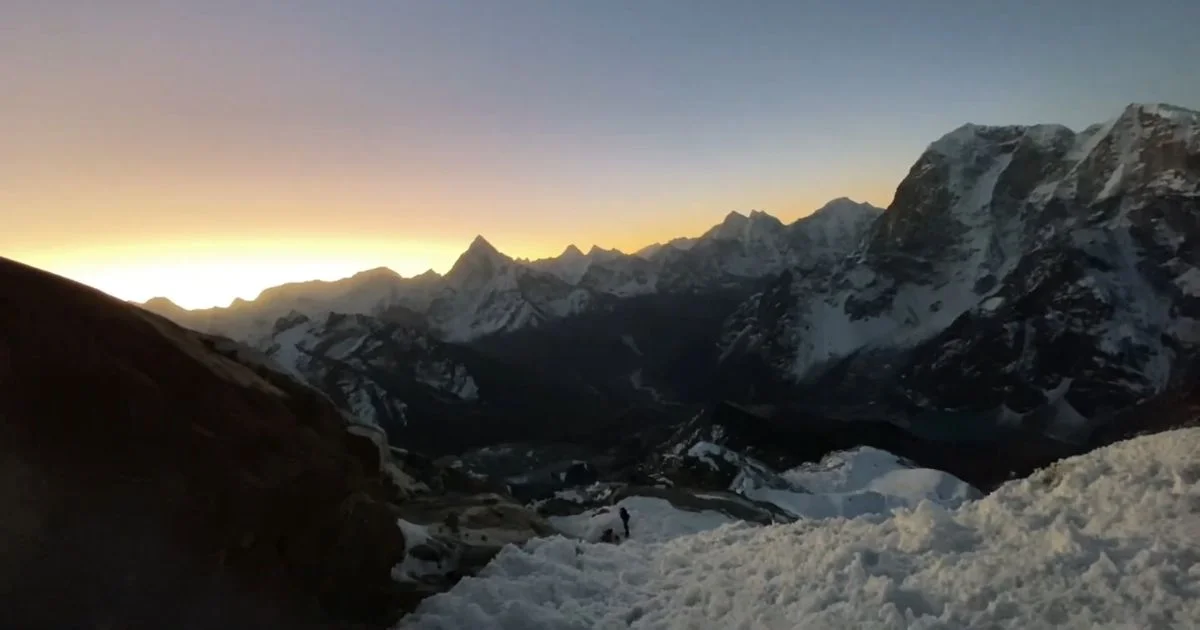
Morning view on the way to lobuche peak
15. Lobuche Peak Climbing Difficulty: FAQs
How Hard Is Lobuche Peak Climbing?
Lobuche Peak climbing difficulty rates as intermediate, requiring solid crampon skills, rope work ability, and strong altitude tolerance up to 6119 metres. Most climbers find it noticeably harder than Island Peak due to steeper summit slopes, longer summit days, and sustained technical sections requiring 10-14 hours of continuous effort at high altitude.
Is Lobuche Peak a Good First Summit?
Lobuche Peak generally isn't recommended as a first mountaineering summit due to altitude demands and technical climbing requirements. Better starter peaks include Mera Peak for altitude experience or Island Peak for a balanced technical and altitude introduction, with Lobuche representing the logical next progression after gaining fundamental climbing skills and high altitude tolerance.
How Long Does It Take to Climb Lobuche Peak?
The complete Lobuche Peak expedition requires 18-21 days from Kathmandu, including the trekking approach, acclimatization, climb, and return. The actual summit push from Lobuche High Camp averages 6-8 hours ascending and 3-4 hours descending, totalling 10-14 hours for the complete summit day effort at extreme altitude.
Do You Need Prior Climbing Experience for Lobuche Peak?
Yes, climbing Lobuche Peak requires prior mountaineering experience, including crampon use, ice axe techniques, fixed rope systems, and glacier travel skills. Previous high altitude exposure above 5000 metres proves essential for realistic altitude tolerance assessment, with most successful climbers having completed peaks like Island Peak or substantial alpine climbing in other ranges.
What Gear Is Essential for Lobuche Peak?
Essential climbing gear includes 6000 m-rated mountaineering boots, an insulated down suit, a harness, crampons, an ice axe, a helmet, ascender/descender devices, and a comprehensive layering system for temperatures reaching -25°C to -30°C. Additionally, climbing equipment like carabiners, prusik cord, a headlamp with spare batteries, and a high altitude-rated sleeping bag prove critical for safety and comfort throughout the Lobuche Peak climb.
Blending digital strategy with mountain passion, I help adventurers find their way to the Himalayas online. With hands-on experience in Nepal’s trekking trails and a role at Nepal Everest Base Camp Trekking Co., Thamel, I combine SEO expertise with true trail insight.