Mera Peak rises to 6,476 metres in the remote Hinku Valley, earning its status as the highest trekking peak in Nepal. As a result, thousands of mountaineers target this snowy giant each year, drawn by its accessible summit route and spectacular Himalayan panorama. However, altitude and glacial terrain make it far more challenging than many first-time climbers anticipate.
This mountain sits within the Makalu Barun National Park, surrounded by some of Earth's tallest summits. In addition, Mera Peak in Nepal offers unobstructed views of five 8,000-metre giants, including Everest, Lhotse, and Makalu. Therefore, both experienced alpinists and ambitious trekkers consider it a worthwhile objective for geographic exploration and personal achievement.
This guide, prepared by Nepal Everest Base Camp Co., examines Mera Peak through a geographic, technical, and environmental lens. It includes a detailed analysis of elevation profiles, climbing routes, seasonal conditions, and common misconceptions related to the highest trekking peak in Nepal. By the end, you will understand what truly defines this prominent peak in Nepal and whether it aligns with your mountaineering goals
Mera Peak at a Glance
Feature
Details
Official Elevation
6,476 meters (21,247 feet), Central Summit
Location Coordinates
27.7172°N, 86.8673°E
Classification
Trekking Peak (Group B by Nepal Mountaineering Association)
Region
Solukhumbu District, Nepal
Protected Area
Makalu Barun National Park
Mera Peak actually consists of three distinct summits. Specifically, Mera North reaches 6,476 metres, making it the highest point. Meanwhile, Mera Central stands at 6,461 metres, and Mera South measures 6,065 metres. As a result, most expeditions target the northern summit because it provides the best panoramic views and represents the true highest trekking peak designation.
Key Summit Distinctions
Mera North: 6,476m, standard objective for most climbing trips
Mera Central: 6,461m, accessed via narrow ridge from North summit
Mera South: 6,065m, rarely climbed due to complex approach
The trekking peak classification matters significantly. Essentially, this designation indicates that Mera Peak requires fewer bureaucratic procedures than full expedition mountains. However, it also creates confusion about difficulty levels. Indeed, many climbers mistakenly assume "trekking" means "easy", when altitude and technical sections demand proper mountaineering preparation.
Geographic Setting and Natural Context
Mera Peak is located in eastern Nepal, specifically within the Hinku Valley drainage system. Therefore, reaching this region of Nepal requires traversing remote trails far from main trekking corridors. Similarly, the Hinku Valley itself runs parallel to the more famous Khumbu Valley, separated by the Zatrwa La pass at 4,610 metres.
Geographic Positioning
Located southeast of the Everest massif by approximately 20 kilometers
Sits entirely within Makalu Barun National Park boundaries
Forms part of the watershed between Hinku Drangka and Hunku Glacier systems
Surrounded by numerous unnamed peaks exceeding 6,000 meters
The Makalu Barun landscape provides dramatic context for Mera Peak. Notably, this protected area spans from subtropical forests at 435 metres to high-altitude zones above 8,000 metres, which are significant for peak climbing in Nepal. Consequently, biodiversity ranges from red pandas and snow leopards to alpine vegetation adapted for extreme cold.
Early exploration of Mera Peak began in 1953 when British mountaineers J.O.M. Roberts and Sen Tenzing made the first recorded ascent. However, confusion about summit identification persisted for decades. Initially, climbers believed they had reached the highest point, but subsequent surveys revealed multiple summit options across the broad summit plateau.
Key Historical Milestones
1953: First recorded ascent via Mera La approach
1975: French team clarifies summit geography through detailed mapping
1980s: Nepal government establishes trekking peak classification system
1990s: Commercial guiding operations begin regular expeditions
2000s onwards: Annual ascents increase dramatically, reaching 400+ climbers per season
Modern mountaineering history shows increasing accessibility to Mera Peak. Specifically, improved trail infrastructure and lodge construction in the Hinku Valley reduced approach difficulty. Moreover, helicopter evacuation options now exist for serious emergencies, thereby changing risk calculations compared to earlier decades.
Regulatory changes also shaped Mera Peak history. Particularly, the climbing permit from the Nepal authorities became standardised through the Nepal Mountaineering Association. Therefore, bureaucratic processes are simplified, making Mera Peak more attractive for international climbers seeking Himalayan experience without full expedition logistics.
Physical Characteristics of Mera Peak
The terrain profile of Mera Peak transitions from rocky moraine to sustained glacier travel. Essentially, the lower Mera base camp at 5,300 metres sits on lateral moraine beside the Mera Glacier. From there, routes ascend through increasingly steep snow slopes, encountering crevasse zones and ice cliffs depending on seasonal conditions.
Elevation Zone
Terrain Type
Key Features
4,000-5,000m
Alpine meadow, moraine
Approach trails, yak pastures
5,000-5,800m
Glacier approach, rocky sections
Base camp, Mera La crossing
5,800-6,400m
Steep snow, crevasse zones
High camp, glacier headwall
6,400-6,476m
Summit ridge, exposed slope
Final 40-50° snow slopes
Glacier systems dominate the upper Mera Peak geography. Specifically, the Mera Glacier and Naulekh Glacier converge below the south face of Mera Peak, creating complex icefalls and seracs. However, standard routes avoid the most dangerous sections by climbing the gentler north face of the Mera approach.
Typical Weather Patterns
Monsoon season (June-September): Heavy snowfall, unstable conditions, minimal visibility
Post-monsoon (October-November): Clear skies, stable weather, best time to climb Mera
Winter (December-February): Extreme cold, strong winds, challenging but possible ascents
Temperature extremes define high-altitude conditions on Mera Peak. Consequently, summit temperatures regularly drop below -25°C during early morning ascents. Furthermore, wind chill further reduces effective temperature, particularly during bad weather systems moving through the Himalayan corridor. Therefore, proper cold-weather gear becomes essential rather than optional.
Mera Peak Climbing Routes Explained
The standard route for Mera Peak climb operations follows the northwest approach from Mera base camp. Specifically, this Mera Peak climbing route ascends through Mera La at 5,415 metres before continuing to Mera High Camp at approximately 5,800 metres. Subsequently, the summit day push covers 650 vertical metres through sustained snow climbing.
Standard North Route Progression
Mera Peak Base Camp (5,300 m) to High Camp via Mera La (5,415 m): 5–7 hours. The route follows a rocky trail with sections of snow and ice, crossing Mera La before continuing onto the glacier toward High Camp.
High Camp (5,800 m) to Mera Peak Summit (6,476 m) and descent to Base Camp: 9–12 hours total. The ascent involves steady climbing on snow slopes using fixed ropes in steeper sections. After reaching the summit, climbers descend carefully along the same route, returning past High Camp and continuing down to Mera Peak Base Camp.
Technical sections intensify above Mera Peak high camp. Indeed, slopes steepen to 40-50 degrees, requiring consistent crampon technique and rope skills. Moreover, crevasse dangers increase on the upper glacier, particularly during warm afternoons when snow bridges weaken. Therefore, most teams start summit pushes between 1 and 3 AM to ensure firm snow conditions.
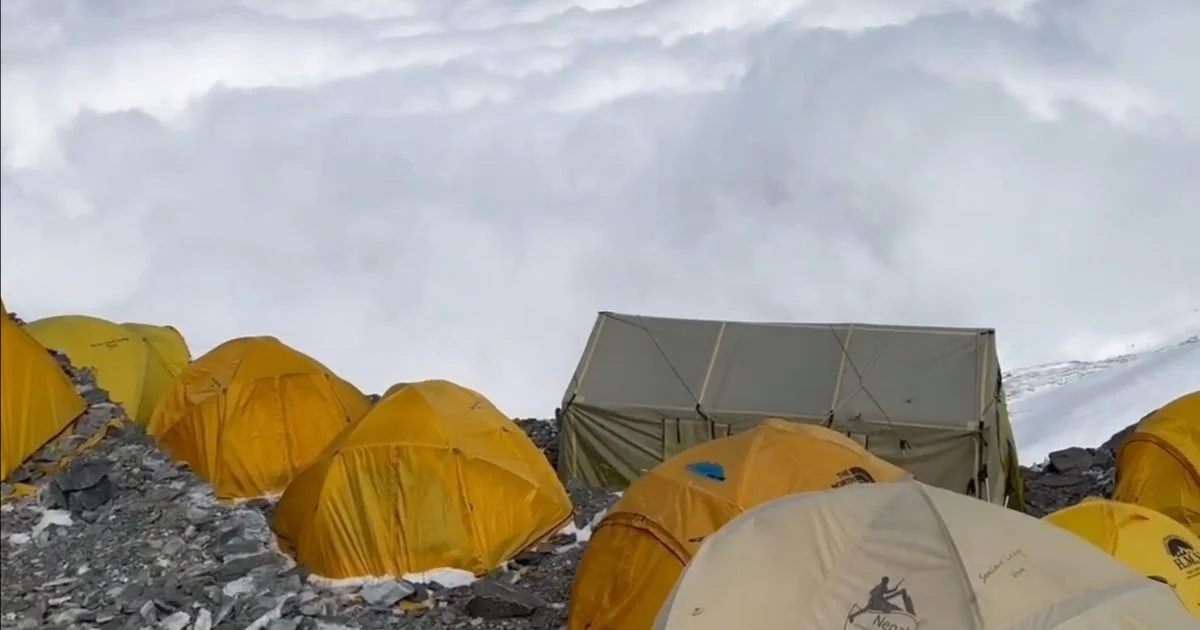
Mera peak base camp
Technical Difficulty and Skill Requirements
Mera Peak presents a moderate technical climb compared to other Himalayan objectives. Essentially, the standard route avoids vertical ice sections and extreme rock climbing. However, sustained glacier navigation, crevasse awareness, and steep snow climbing require genuine mountaineering competence beyond basic trekking skills.
Skill Category
Required Level
Application on Mera
Crampon technique
Intermediate
Sustained use on 40-50° slopes
Ice axe arrest
Essential
Safety on exposed sections
Fixed rope ascent
Basic to intermediate
Jumar technique on summit push
Crevasse awareness
Intermediate
Route finding through glacier zones
Altitude management
Critical
Acclimatization and pace control
Altitude fundamentally changes difficulty perception for Mera Peak climb attempts. Specifically, tasks simple at sea level become exhausting above 6,000 metres. Consequently, climbers with excellent technical skills but inadequate altitude preparation often struggle more than moderately skilled mountaineers who acclimatise properly.
Realistic Skill Assessment
Previous climbing experience on glaciated terrain strongly recommended
Basic climbing skills must include self-arrest, crampon walking, rope travel
Physical fitness equivalent to multi-day mountain trekking with loaded pack
Mental preparation for cold, fatigue, and altitude-induced discomfort
Why Mera Peak Is Classified as a Trekking Peak
The Nepal Mountaineering Association designates Mera Peak as a Group B trekking peak, distinguishing it from full expedition mountains. Specifically, this classification means climbers obtain permits through simplified procedures rather than the Department of Tourism's expedition process. However, the "trekking" label creates widespread confusion about actual difficulty.
Classification Distinctions
Trekking peaks in Nepal: 33 mountains under 7,000m with simplified permitting
Expedition peaks: Major mountains requiring full expedition permits, liaison officers, extensive documentation
Mera Peak is considered technically accessible but still demands genuine mountaineering skills
Group A trekking peaks (under 6,500m): Generally less technical than Group B
Common misunderstandings arise because "trekking" implies walking rather than climbing. Indeed, many aspiring climbers book Mera Peak trek packages expecting an extended hike with a steep final section. In contrast, reality proves different when facing sustained glacier travel, altitude effects, and technical rope work at extreme elevation.
The classification system serves administrative rather than technical purposes. Therefore, Mera Peak is the highest designated trekking peak, but elevation alone doesn't determine difficulty. In fact, some lower-elevation peaks require more advanced technical skills due to rock climbing or vertical ice sections.
Altitude and Acclimatization Considerations
Human physiology changes dramatically above 5,500 metres, entering the high-altitude zone where oxygen pressure drops significantly. Consequently, proper acclimatization becomes the single most important factor for successfully summiting Mera Peak. Notably, most failed attempts result from altitude sickness rather than technical inability or poor weather.
Altitude Zone
Oxygen Availability
Physiological Effects
3,000-4,000m
~75% of sea level
Mild breathlessness, sleep disruption
4,000-5,500m
~65% of sea level
Increased heart rate, reduced appetite
5,500-6,500m
~50% of sea level
Significant performance drop, AMS risk
Above 6,500m
~45% of sea level
Extreme zone, physiological deterioration
Effective acclimatization for Mera Peak requires strategic altitude gain. Specifically, most successful itineraries include multiple rest days at intermediate elevations, allowing red blood cell production and physiological adaptation. Moreover, the "climb high, sleep low" principle applies during the acclimatization day schedule leading to base camp.
Warning Signs of Altitude Problems
Persistent headache unrelieved by standard pain medication
Nausea, vomiting, loss of appetite beyond normal altitude effects
Extreme fatigue disproportionate to physical exertion
Confusion, difficulty with coordination, behavioral changes
Shortness of breath at rest, indicating possible pulmonary edema
The Mera Peak itinerary typically spans 18 days, with 12-14 trekking days devoted to approach and acclimatization. Therefore, rushed schedules dramatically increase altitude illness risk and summit failure rates. Furthermore, adequate preparation acknowledges that training for Mera Peak must include altitude exposure, not just physical conditioning at sea level.
Seasonal Conditions on Mera Peak
Peak trekking seasons occur during spring (March-May) and autumn (October-November) when weather patterns stabilise. Specifically, spring conditions offer warmer temperatures and deeper snow, while autumn provides colder temperatures with better snow consolidation. As such, each season presents distinct advantages and challenges for those attempting to reach the summit of Mera.
Season
Temperature Range
Conditions
Spring (Mar-May)
-15°C to -25°C summit
Warmer, afternoon clouds, deeper snow
Autumn (Oct-Nov)
-20°C to -30°C summit
Clear skies, stable weather, firm snow
Winter (Dec-Feb)
-30°C to -40°C summit
Extreme cold, strong winds, clear views
Monsoon (Jun-Sep)
-10°C to -20°C summit
Heavy snow, poor visibility, dangerous
Snow stability varies dramatically between seasons, affecting route safety and summit day conditions. Particularly, spring snowpack can become unstable during warm afternoons, increasing avalanche risk on steep slopes. Conversely, autumn snow typically consolidates better, providing firmer surfaces but potentially more exposed ice on windswept sections.
Seasonal Decision Factors
Spring: Better for those sensitive to cold, more crowded base camp areas
Autumn: Clearer views of Mera Peak, better summit photography, more stable weather windows
Winter: Only for experienced mountaineers comfortable with extreme cold and technical climbing in the Himalayas
Summer monsoon: Strongly discouraged due to avalanche danger and zero visibility
Weather window identification becomes critical for the final summit push. Indeed, bad weather can arrive rapidly in the Himalayas, trapping climbers above high camp or forcing dangerous descents in whiteout conditions. Therefore, experienced guides monitor weather forecasts closely and maintain flexible schedules to capitalise on optimal conditions.
Views and Summit Panorama
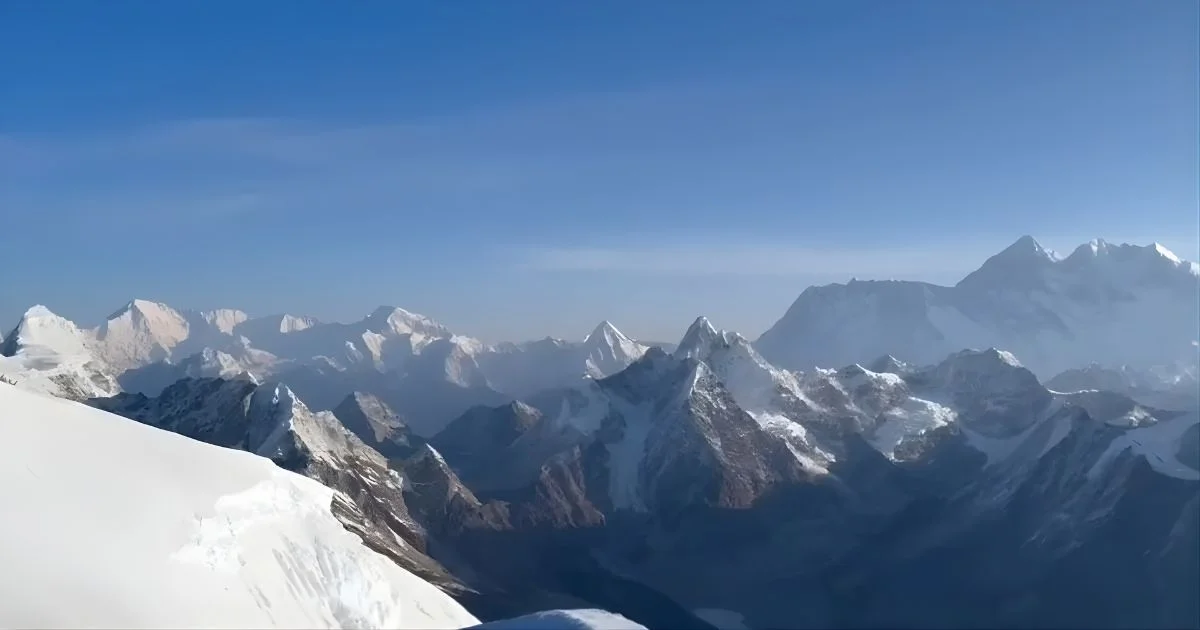
The panoramic vista from Mera Peak summit ranks among the finest in Nepal. Specifically, climbers enjoy unobstructed views of five 8,000-metre peaks, a concentration unmatched by most other vantage points in the Himalayas. Consequently, many mountaineers prioritise Mera Peak specifically for photographic and geographic observation opportunities.
Visible 8,000-Meter Peaks
Everest (8,849m): Clearly visible to the northwest, south face prominent
Makalu (8,485m): Dominates the northeast view, closest 8,000m peak
Lhotse (8,516m): Adjacent to Everest, distinctive profile
Cho Oyu (8,188m): More distant northwest, still recognizable
Kanchenjunga (8,586m): Visible on clear days to the far east
Geographic significance extends beyond famous peaks. Indeed, the top of Mera peak provides educational perspective on Himalayan structure, glacial systems, and alpine geography. Moreover, the views of Mera from surrounding valleys illustrate how this mountain dominates local topography despite being dwarfed by the 8,000-metre giants.
Photographic conditions depend heavily on seasonal weather and time of day. Particularly, early morning light during summit day offers the best clarity and dramatic shadows across distant peaks. However, afternoon clouds frequently obscure views by midday, reinforcing the importance of alpine-style early starts for the final ascent.
Mountain View from Mera Peak Summit
Equipment and Preparation Essentials
Proper climbing gear separates successful ascents from dangerous attempts on Mera Peak. Specifically, climbing equipment must handle sustained glacier travel, extreme cold, and technical rope sections. Moreover, gear choices significantly impact safety margins during unexpected weather changes or route complications.
Equipment Category
Essential Items
Purpose
Footwear
Plastic mountaineering boots, 12-point crampons
Warmth, crampon compatibility, technical terrain
Protection
Climbing harness, helmet, ice axe
Fall protection, fixed rope use, self-arrest
Insulation
Down suit, insulated gloves, balaclava
Extreme cold protection, wind resistance
Technical gear
Jumar, carabiners, prusik cord
Fixed rope ascent, safety systems
Sleep system
-25°C sleeping bag, insulated pad
High camp comfort, recovery
Physical preparation extends beyond standard fitness training. Specifically, cardiovascular conditioning must simulate extended effort at altitude, while strength training should focus on leg endurance for sustained uphill travel. Moreover, training for Mera Peak ideally includes practice climbs on glaciated terrain to develop technical muscle memory.
Preparation Timeline Recommendations
6-12 months: Begin cardiovascular base building, altitude exposure if possible
1-3 months: Peak fitness phase, gear testing, route research
Final month: Taper training, finalize logistics, mental preparation
Mental preparation often receives insufficient attention despite its critical importance. Indeed, the Mera Peak climbing adventure demands psychological resilience for dealing with discomfort, fatigue, and altitude-induced mood changes. Therefore, realistic expectations about difficulty help climbers maintain positive attitudes during challenging moments.
Safety, Risk, and Rescue Context
Objective dangers on Mera Peak include crevasse falls, avalanche exposure, altitude illness, and weather-related emergencies. Specifically, crevasses pose constant risk on glacier sections, particularly during warm conditions when snow bridges weaken. Moreover, avalanche danger increases on steep slopes following heavy snowfall or during rapid temperature changes.
Primary Risk Categories
Altitude sickness: Most common serious problem, can progress rapidly to life-threatening conditions
Crevasse falls: Hidden crevasses on glacier routes, rope travel essential
Cold injury: Frostbite risk on fingers, toes, face during extended summit attempts
Exhaustion: Physical depletion at altitude reduces judgment and increases accident risk
Emergency evacuation from Mera Peak presents significant logistical challenges. Specifically, helicopter rescue becomes difficult or impossible during bad weather, and walking evacuation from high camp requires multiple days even for relatively mobile patients. Therefore, prevention through proper acclimatization and conservative decision-making remains far superior to relying on rescue capabilities.
Working with experienced climbing guides substantially improves safety margins. Indeed, professional guides recognise early warning signs of altitude problems, weather changes, and route hazards that inexperienced climbers might miss. Moreover, guide networks provide coordination for emergency response when problems arise beyond individual team capabilities.
Environmental and Cultural Environment
Alpine ecosystems in the Hinku Valley transition from rhododendron forests below 4,000 metres to barren snow zones above 5,500 metres. Consequently, biodiversity concentrates at lower elevations, while upper regions support only specialised organisms adapted for extreme conditions. The Mera Peak trail passes through multiple ecological zones, illustrating dramatic altitude-driven environmental changes.
Elevation Zone
Vegetation
Wildlife
2,000-3,500m
Mixed forest, bamboo
Red panda, Himalayan black bear
3,500-4,500m
Rhododendron, juniper
Musk deer, Himalayan tahr
4,500-5,500m
Alpine shrubs, grasses
Snow leopard, blue sheep
Above 5,500m
Sparse lichens, mosses
Occasional birds, minimal mammals
Makalu Barun National Park regulations require permits and impose environmental protection rules. Specifically, all waste must be carried out, campfires are prohibited above certain elevations, and designated camping areas must be used where established. Additionally, these conservation measures protect fragile alpine ecosystems from the increasing impact of mountaineering tourism.
Cultural presence in the Hinku Valley remains limited to seasonal settlements and occasional herding activities. However, Sherpa communities maintain traditional connections to the region, and Buddhist cultural elements appear in the form of prayer flags, stone monuments, and occasional monasteries at lower elevations. Thus, respecting local customs enhances the cultural dimension of any Mera Peak expedition.
Permits and Regulatory Framework
The Mera Peak climbing permit is issued by the Nepal Mountaineering Association rather than the Department of Tourism. Specifically, this simplified process distinguishes trekking peaks from full expedition mountains, reducing bureaucratic complexity and permit costs. However, multiple permits remain necessary for legal access to the mountain and surrounding protected areas.
Permits for Mera Peak Include
Climbing permit: USD 250 for spring, USD 125 for autumn (2024 rates), obtained through NMA
Makalu Barun National Park entry: USD 30 per person, required for all trekkers
Local area permit: USD 10. Collected by local authorities in the Mera region.
TIMS card (Trekkers' Information Management System): USD 30. Mandatory registration for trekkers in Nepal.
Permit acquisition typically occurs through registered trekking agencies rather than individual applications. Consequently, most climbers arranging Mera Peak climbing tour packages receive permits as part of comprehensive service bundles. However, independent climbers must navigate the permit process directly, which requires Kathmandu-based agency coordination regardless of approach style.
Regulatory changes occasionally affect permit costs and requirements. Therefore, verifying current regulations before planning remains essential, as outdated information can create logistical problems upon arrival in Nepal. Similarly, the Nepal Mountaineering Association website provides official current information, though processing often requires in-person visits to their Kathmandu office.
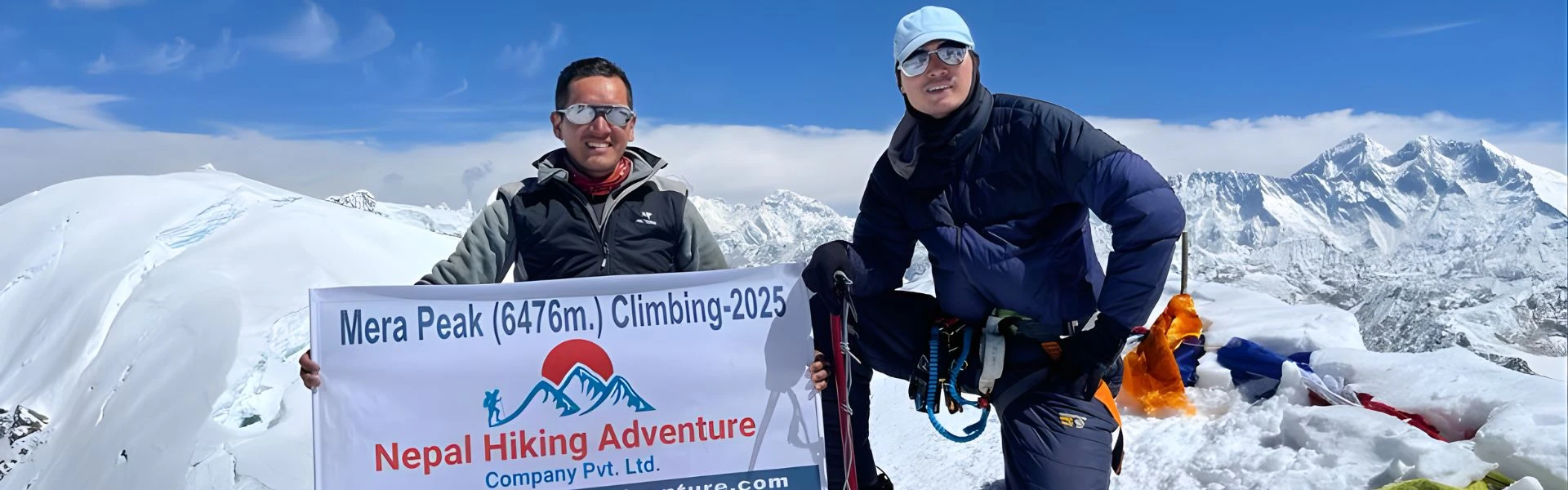
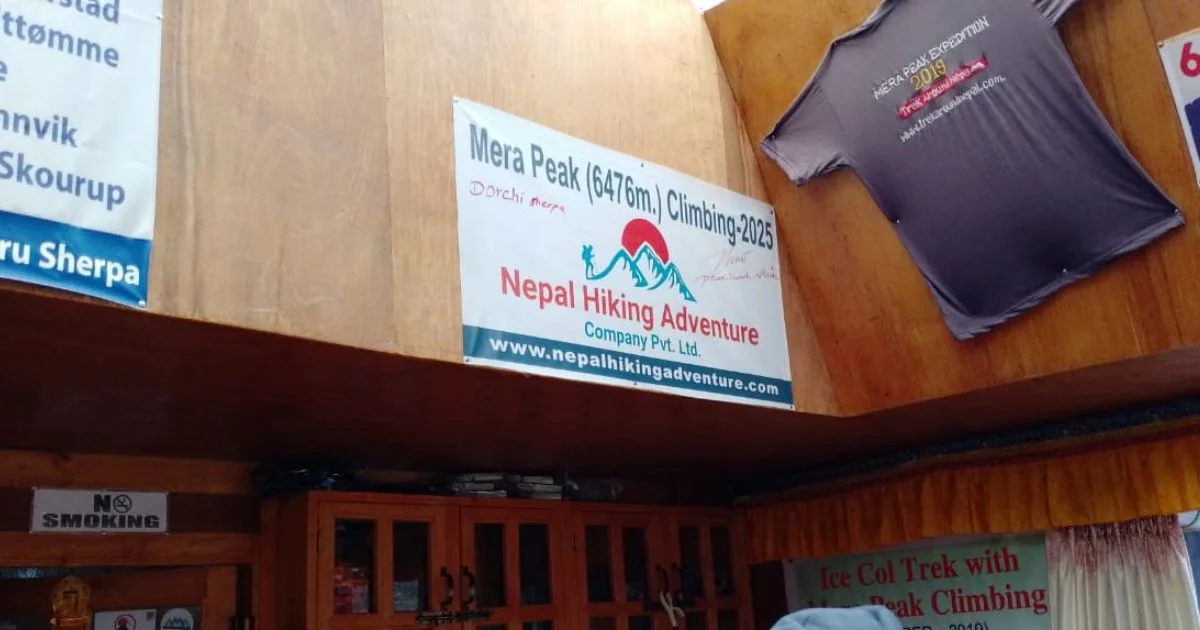
Mera peak Banner NHA
Mera Peak Compared With Other Popular Peaks
Mera Peak vs Island Peak
Island Peak (6,189 m) offers more technical climbing with steeper ice sections and greater rock involvement. Specifically, Island Peak requires confident vertical ice climbing and exposed ridge traverses. Meanwhile, Mera Peak focuses on endurance and altitude management rather than pure technical difficulty. Moreover, Island Peak sits closer to Everest Base Camp trekking routes, making approach logistics simpler but potentially more crowded.
Feature
Mera Peak
Island Peak
Elevation
6,476 m
6,189 m
Technical Difficulty
Moderate glacier climbing
Steeper ice, exposed ridge
Approach Duration
7-8 days
5-6 days
Summit Views
Five 8,000m peaks
Everest, Lhotse, Makalu
Crowds
Moderate
Higher (proximity to EBC)
Mera Peak vs Lobuche East
Lobuche East (6,119 m) demands more advanced mountaineering skills than Mera Peak. Particularly, Lobuche Peak climbing involves exposed knife-edge ridges, mixed rock and ice climbing, and greater objective danger from rockfall. However, Lobuche's proximity to Everest Base Camp makes it logistically convenient for climbers already acclimatised in the Khumbu region.
Choosing Mera Peak for First-Time Climbers
Mera Peak serves well as a first Himalayan climbing peak in Nepal for those with basic mountaineering training. Specifically, the gradual approach allows proper acclimatization, technical demands remain moderate, and support infrastructure exists throughout the route. However, first-timers must understand that "trekking peak" classification doesn't guarantee success without proper preparation and realistic fitness levels.
Common Myths and Misconceptions
"Easy Peak" Narratives Explained
The most dangerous misconception treats Mera Peak as merely an extended trek with a steep finish. In reality, sustained glacier travel, extreme altitude, and technical rope work create genuine mountaineering challenges. Moreover, the highest trekking peak in Nepal designation attracts climbers unprepared for the physical and mental demands of multi-day ascents above 6,000 metres.
Key Reality Checks
No Himalayan peak above 6,000m qualifies as "easy" by any objective standard
Trekking peak classification addresses permitting, not difficulty
Summit success rates hover around 60-70%, indicating significant challenge
Altitudesickness affects even supremely fit individuals without proper acclimatization
Altitude Underestimation and Real Risks
Many climbers underestimate how severely altitude affects performance and judgement. Specifically, the top of Mera sits at an extreme altitude where human bodies actively deteriorate rather than simply functioning at reduced capacity. Consequently, decisions that seem reasonable at lower elevations become dangerous above 6,000 metres. Furthermore, even experienced mountaineers struggle with altitude effects on unfamiliar peaks.
Experience vs Fitness Misjudgements
Exceptional cardiovascular fitness doesn't substitute for mountaineering experience on Mera Peak. Indeed, marathon runners and ultra-endurance athletes regularly struggle with technical sections, crevasse navigation, and equipment use despite superior fitness levels. Conversely, moderately fit climbers with solid rope skills and glacier experience often perform better by maintaining appropriate pace and technique throughout the ascent.
Mera Peak: Final Thoughts
Mera Peak stands as a legitimate Himalayan mountaineering objective rather than an elevated trekking route. Therefore, successful ascents demand proper technical training, realistic altitude preparation, and appropriate respect for the mountain's hazards. Similarly, the summit of Mera Peak rewards prepared climbers with extraordinary panoramic views and genuine mountaineering achievement.
This climbing peak in Nepal occupies an important middle ground in Himalayan mountaineering. Specifically, it provides an accessible introduction to extreme altitude without requiring advanced technical skills or full expedition logistics. However, accessibility doesn't imply ease, and the mountain claims its share of unsuccessful attempts from underprepared parties each season.
Ultimately, Mera Peak is one of the world’s finest altitude training grounds and viewpoint summits, rewarding climbers who approach this trekking peak in Nepal with proper preparation, realistic expectations, and genuine mountaineering competence. The mountain demands respect but offers lasting value for those ready to accept the challenges of Himalayan ascents, and with experienced local guidance from Nepal Everest Base Camp Co., you can assess whether this climb suits your goals. To plan responsibly and confidently, contact us for expert advice on your Mera Peak expedition.
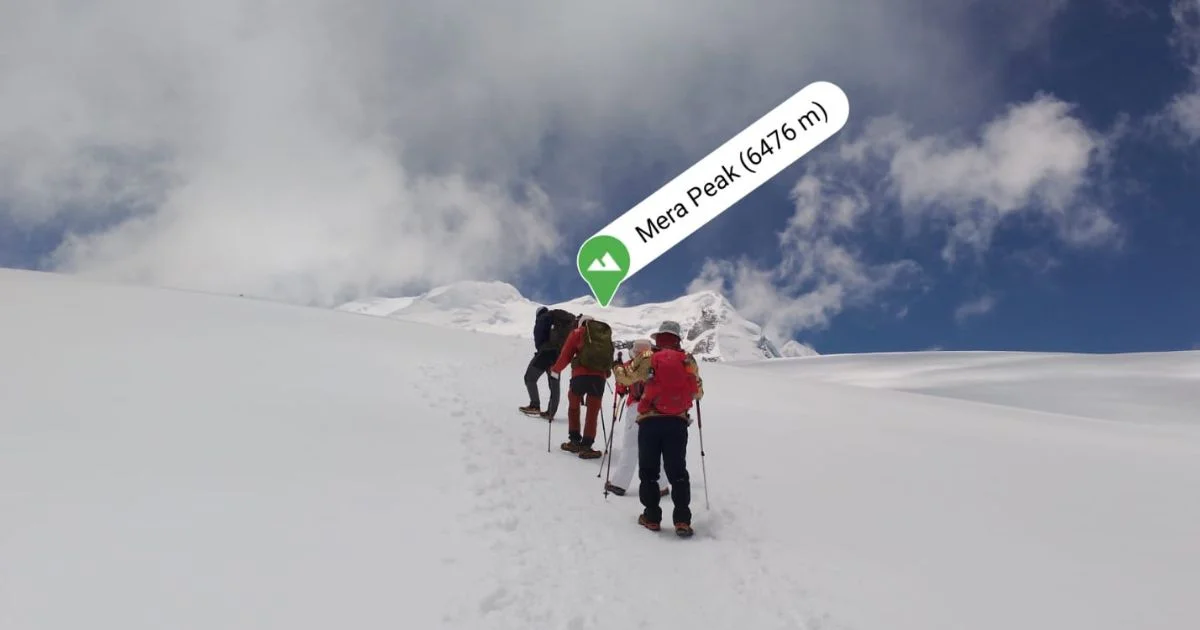
On the way to mera peak summit
Mera Peak: FAQs
How Hard Is Mera Peak Compared to Other Peaks?
Mera Peak ranks as moderately difficult among popular trekking peaks in Nepal. While less technical than Island Peak, it presents greater altitude challenges. Notably, the Mera Peak climb demands sustained physical effort, basic mountaineering skills, and excellent altitude adaptation rather than advanced climbing techniques. Furthermore, those planning to join Mera Peak expeditions should understand that endurance matters as much as technical ability.
Do You Need Prior Mountaineering Experience?
Yes, previous climbing experience on glaciated terrain strongly benefits Mera Peak attempts. Basic climbing skills, including crampon use, ice axe arrest, and fixed rope ascent, are essential. However, extreme technical expertise isn't necessary, making it possible to climb Mera Peak for those with fundamental mountaineering training and proper preparation. Additionally, understanding what's required for Mera Peak helps set realistic expectations before committing to the expedition.
How Long Does the Summit Ascent Take?
The summit day push from Mera high camp typically requires 6-8 hours ascending and 3-4 hours descending. However, the complete Mera Peak climbing trip spans approximately 18 days including approach, acclimatization, and return. Moreover, weather conditions and individual fitness significantly affect timing for the final climb to the summit. The itinerary for the Mera Peak expedition must account for flexible scheduling to capitalise on optimal weather windows.
Is Mera Peak Safe for First-Time Climbers?
Mera Peak can serve as a first Himalayan objective for properly trained climbers. However, "first-time" shouldn't mean "inexperienced". Specifically, climbers should complete glacier training, practise crampon techniques, and ideally climb smaller peaks before attempting Mera Peak. Furthermore, working with experienced climbing guides dramatically improves safety margins for less experienced mountaineers. Those planning to trek and climb Mera Peak should invest adequate time in skill development before departure.
What Is the Success Rate on Mera Peak?
Success rates for attempting to summit Mera Peak range between 60% and 70%, depending on the season and weather conditions. Most failures result from altitude illness rather than technical inability. Therefore, proper acclimatization through well-planned itineraries remains the most critical factor for reaching the summit successfully. Additionally, understanding the camp of the Mera Peak structure and progression helps climbers pace themselves appropriately throughout the ascent.
What Additional Costs Should I Expect?
Beyond the basic permit from the Nepal Mountaineering Association, climbers should budget for various additional costs. These include extra cost items such as personal gear purchases, emergency evacuation insurance, tips for guides and porters, and contingency funds for weather delays. Specifically, the trek to Mera Peak involves accommodation, meals, and transportation that vary depending on the service level chosen. Moreover, helicopter rescue coverage adds significant but essential extra cost to overall expedition budgets.
Can Mera Peak Be Climbed in Winter?
Mera Peak in winter presents extreme challenges suitable only for experienced mountaineers. Specifically, temperatures can drop to -40°C, and high winds create dangerous wind chill conditions. However, winter ascents offer clearer skies and fewer crowds for those equipped to handle extreme cold. Additionally, climbers attempting Mera Peak in winter should have previous high-altitude experience and comprehensive cold-weather gear systems.
What Is the Route From Base Camp to Summit?
The standard climb from Mera base camp progresses through Mera La to high camp, then onwards to the summit via the north face of Mera. Specifically, teams establish the Mera Peak base camp at approximately 5,300 metres, then move towards Mera Peak high camp at 5,800 metres. Subsequently, the summit push from camp of Mera Peak covers 650 vertical through steep snow slopes. Therefore, understanding this progression helps climbers mentally prepare for the physical demands of each stage while moving steadily towards Mera Peak and its rewarding summit panorama.
Blending digital strategy with mountain passion, I help adventurers find their way to the Himalayas online. With hands-on experience in Nepal’s trekking trails and a role at Nepal Everest Base Camp Trekking Co., Thamel, I combine SEO expertise with true trail insight.